An annual summit spurred by a Pittsburgh mass shooting turned its attention on Tuesday to the role artificial intelligence is playing in radicalization, especially among young people.
The Eradicate Hate Global Summit began in 2021, organized by Pittsburgh community members following the Pittsburgh synagogue shootings in 2018, in which 11 people were slain in the deadliest attack on Jews in U.S. history.
Survivors, state officials, doctors, religious leaders and researchers from across the world gather annually to discuss how to combat hate and violence and serve victims.
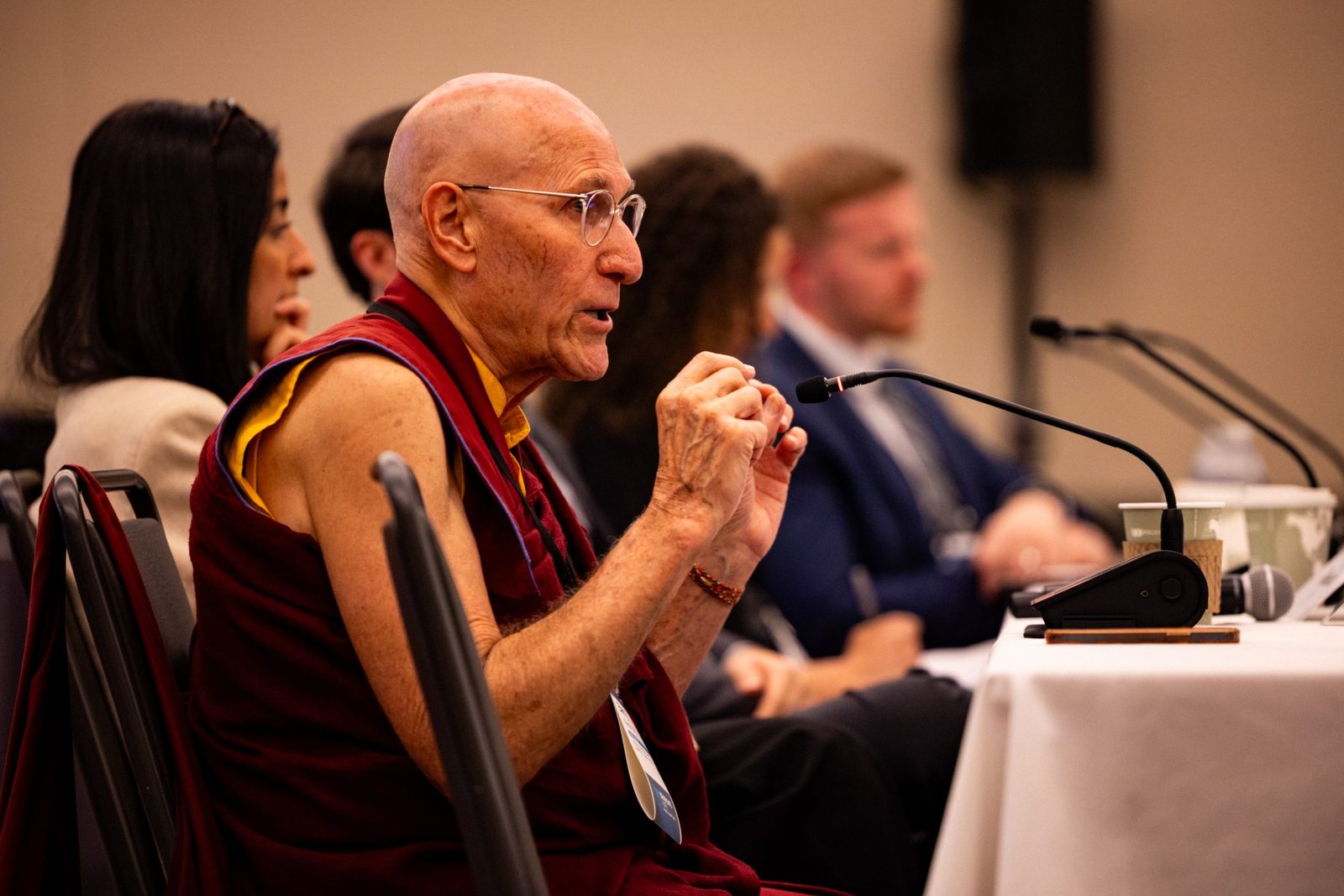
At the David L. Lawrence Convention Center, Downtown, five experts spoke Tuesday on a panel about how AI is being used to promote extremism and violence — and how it can be used to stop it.
Here’s what they had to say.
‘Slop’ and ‘brainrot’ can be insidious
“AI slop” or “brainrot” refers to low-quality, memeified, AI-generated internet content that’s spammed social media and become particularly popular among young people in recent years.
Panelist Matt Kriner, executive director of the Institute for Countering Digital Extremism [ICDE], said while it may appear niche and harmless, the content has a disturbing connection to radicalized young people.

“The majority of the recent school shooters that we’ve investigated have engaged in this kind of content … thoroughly,” Kriner said during the panel. “It’s increasingly becoming a part of their identity, it’s a part of their radicalization process, and somehow that is replacing ideology.”
ICDE is working to understand the online cultural spaces where these memes proliferate — with the hopes of identifying individuals who fall through the cracks.
“They’re losing touch with reality,” Kriner said. “And that’s making it harder for us to detect what’s legitimate threats, what’s credible, and what’s not.”
Chat bots and threats to teens
Increasingly, when young people seek facts, they trust AI more than they trust other people, said Daniel Relihan, deputy director of research at American University’s Polarization and Extremism Research and Innovation Lab.
This trust has led to the proliferation of young people forming parasocial relationships with artificial chat bots, like Character.ai and ChatGPT.

These chatbots are trained to be personalized and can understand each individual’s vulnerabilities, Relihan said — and how to take advantage of those vulnerabilities. He noted the numerous cases of teens who have turned to chatbots as a “suicide coach.”
Bots could speed the radicalization of vulnerable people, he said.
“Traditional radicalization has had natural speed bumps or friction over time,” Relihan said. “Other people might challenge extreme views, friendships might intervene.”
But with AI, those speed bumps are removed. If a chatbot doesn’t confirm someone’s beliefs, they can “AI shop” until they find one that does, making it even more difficult for researchers to figure out how and where to intervene. Relihan said a study from West Point last year found people could bypass generative AI platforms’ safeguards against violent extremism 50% of the time.
Extremist groups’ use of AI
AI can also be used directly by violent extremist groups to spread propaganda, the panelists said.

Not only can extremist groups use AI to refine their target audiences, but they can translate their materials more effectively to reach more people, said Liliane Vincente of the United Nations Office of Counter-Terrorism.

Relihan said that because AI pulls information from internet websites to generate its results, some U.S. adversaries are posting “thousands” of neo-Nazi websites online, with the goal that it will be regurgitated by chatbots.
“I don’t mean to be alarmist — this is what keeps me up at night,” Relihan said.
‘We are inoculators’
In spite of the horrifying possibilities for AI to manipulate and be manipulated for violence, it also presents opportunities for good. Venerable Barry Kerzin, a Tibetan Buddhist monk and University of Pittsburgh professor, noted the medical and environmental breakthroughs already being produced with AI.
In his work as the founder and president of the Altruism in Medicine Institute, Kerzin has partnered with Google Deep Mind to try to embed “altruistic algorithms” into artificial intelligence. But it’s difficult to program compassion into computers, he said. Now, he educates the scientists who create AI tools on compassion.

Panelists spoke about the “psychological inoculation” required to safeguard against AI-proliferated propaganda. The best tools, they said, are education and skepticism. To protect people, especially children, from radicalization, people should learn the warning signs, turn to their trusted communities and call for regulation on AI.
“We are inoculators,” Kerzin said. “We inoculate compassion.”
Shapiro: Trump ‘failed the morality test’
Earlier Tuesday at the summit, Gov. Josh Shapiro of Pennsylvania said that the nation’s leaders must “turn the tide” against political violence and reject vengeance, and accused President Donald Trump of failing the moment’s test of leadership.
Shapiro, a Democrat, delivered remarks as the keynote speech at the summit, days after the assassination of conservative political activist Charlie Kirk, and later, while answering reporters’ questions.
Shapiro said political leaders must condemn all forms of political violence and reject the “rhetoric of vengeance.”
“It is all wrong, and it makes us all less safe. During moments like these, I believe we have a responsibility to be clear and unequivocal in calling out all forms of political violence, making clear it is all wrong,” Shapiro said. “That shouldn’t be hard to do.”
Shapiro has criticized Trump as using the “rhetoric of rage” in the wake of Kirk’s killing, and on Tuesday, he again pointedly singled out the president while speaking to reporters.
Trump and some of his allies are “cherry-picking certain violence that is OK and certain violence that is not OK, that is making everyone less safe and it’s raising the temperatures instead of lowering the temperatures,” Shapiro said.
“I don’t care if it’s coming from the left or the right. We need to be universal in our condemnation. And the president has once again failed that leadership test, failed the morality test, and it makes us all less safe,” Shapiro said.
Trump has repeatedly blamed Kirk’s killing on “ the radical left” or said the problem of political violence “is on the left.”
The White House responded in a statement Tuesday that Trump — as the survivor of assassination attempts and a close friend of Kirk — understands the dangers of political violence better than anyone, and that he and his administration maintain that “radical leftists” have inspired left-wing violence by calling political opponents “Nazis and fascists.”
“It must end,” the White House said.
In April, Shapiro and his family fled the governor’s official residence in the middle of the night after an alleged arsonist broke in and set it on fire in an attempt to kill Shapiro.
In his remarks, Shapiro said too many people don’t believe government and the nation’s institutions can solve problems. Instead, they find refuge on the internet where their frustration is taken advantage of and used to foment hate, he said.
“It leads to a belief among some that the only way they can address their problems is through violence,” Shapiro said. “They find online those who glorify violence and urge it on.”
Tory Basile is an editorial intern at Pittsburgh’s Public Source and can be reached at tory@publicsource.org.
The Associated Press contributed.