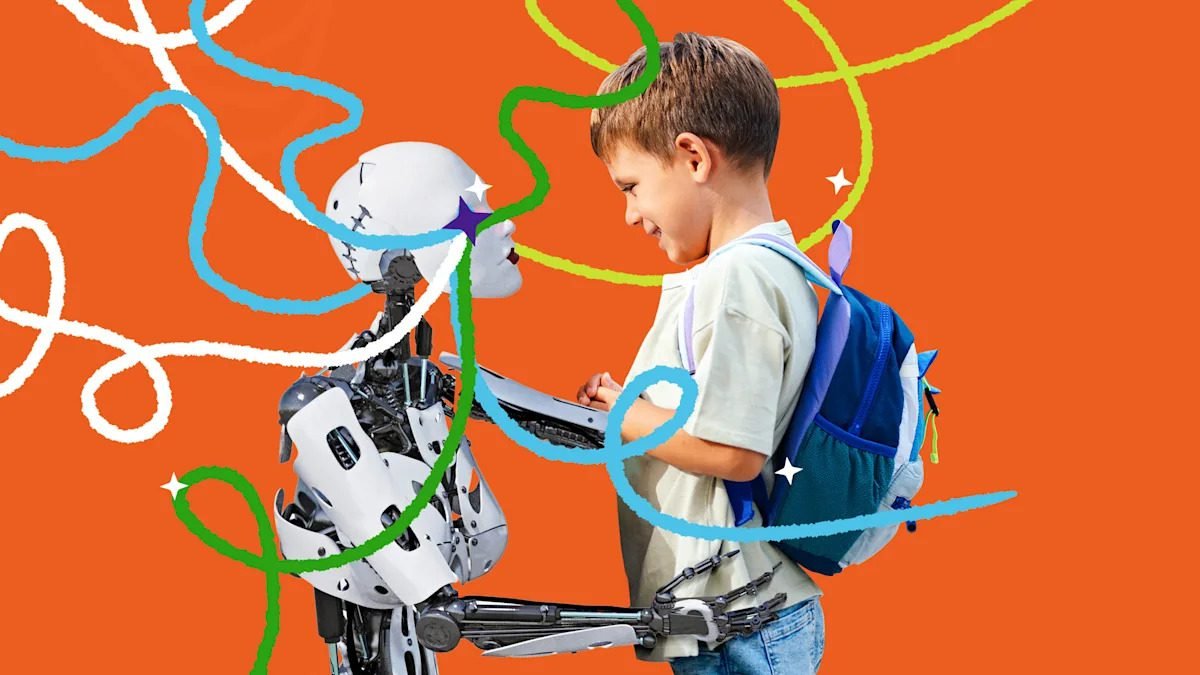
It’s no secret that I hate AI. I kvetch about it on social media. What can I say? I’m an English major who values actual sentences and a journalist whose job AI is, by all accounts, trying to take over (it’ll never win! Right?!?). But I also hate that AI seems to have so little grip on real life — especially the messy, sticky, endlessly unpredictable real life of parenting.
I’ve rolled my eyes at friends who use ChatGPT for advice on handling a toddler meltdown or planning a birthday party. I’ve ignored the chorus of “It can actually be super helpful,” preferring to parent without any high-tech shortcuts or input from a bot.
But then came late July and the dreaded 2.5-week period between my younger kid’s day care ending for the summer and my oldest’s public school starting again for the fall. And desperate times, as they say, call for truly desperate measures.
So I decided to try the thing I’ve been avoiding: I asked AI to help me parent. For an entire week.
Day 1: Indoor activities for a preschooler (and my sanity)
My first prompt was one I’d overheard another parent mention: “Give me age-appropriate activities for a 3-year-old indoors.” The “indoors” part was necessary because temperatures in my home state of Tennessee had hit 100 for almost an entire week. ChatGPT spit back a list of options, from sensory bins to scavenger hunts. I picked the simplest: “pasta threading.” Dry rigatoni and string? Excellent.
Within minutes, my preschooler was happily threading noodles into a lopsided necklace while I typed a few emails. Was it Montessori-level engagement? No. Was it quiet? Yes.
Verdict: A surprisingly strong start.
Day 2: School anxiety pep talk
My almost-10-year-old had started fretting about the upcoming school year, which in Tennessee begins, bafflingly, the first week of August. So I tried: “How can I help my child deal with anxiety about school?” ChatGPT suggested role-playing first-day scenarios and doing a “practice walk” to school. The latter was not particularly helpful since the public school is two blocks away, and we already walk past it to get just about anywhere.
So I ended up going with the bot’s tip to make a goofy “first-day playlist” together. Dancing around the kitchen to “I’m a Gummy Bear” in German (yes, it exists) got my son giggling instead of worrying. And, bonus: I didn’t have to Google my way through 10 articles giving contradictory advice.
Verdict: It felt like asking my Gen Z baby brother for parenting ideas. He’ll toss out five out-of-touch duds and then, somehow, one genius hack I’ve never thought of.
Day 3: Kid karaoke fail
It continued to be 100 degrees out, so I thought karaoke might burn off some energy. I asked ChatGPT: “Give me karaoke songs for kids.” It listed a bunch of classics from “Yellow Submarine” to “Shake It Off,” none of which my kids were even remotely interested in.
“WE WANT TO SING KPOP DEMON HUNTERS!” they demanded. But they couldn’t remember any of the song names. So I asked ChatGPT, this time very specifically: “Now give me ‘KPop Demon Hunters’ karaoke songs for kids.” But this bot had clearly been living under an internet rock, because it apparently had not heard of the most-watched original animated movie in Netflix history. Its response: “If you’re looking for K-pop songs with a ‘demon hunter’ vibe that are still fun and kid-friendly for karaoke, you want tracks that have: an adventurous or fantasy feel (epic beats, dramatic concepts, maybe supernatural references).” What??
We gave up on the karaoke.
Verdict: Read the room, robot.
Some high-tech help can certainly take the edge off.”
Day 4: Chore chart revolution
Like many parents, I dream of a home in which my kids actually do chores without 15 daily reminders. So I tried: “Make a chore chart for a family of four with kids ages 3 and 10.” ChatGPT gave me a simple grid with age-appropriate tasks: toy pickup and feeding the cat for the 3-year-old, vacuuming and setting the table for the 10-year-old.
We read it aloud. We printed it. We color-coded it. We stuck it on the fridge. And it actually worked to get the kids starting their chores — at least for the first 48 hours. Ask me again next week.
Verdict: Nice, but AI can’t force follow-through.
Day 5: Book matchmaker
By midweek, my older son needed a screen break, stat. I decided to take the kids to the library. I asked ChatGPT: “Give me book recommendations for a 10-year-old who loves Tintin, Dog Man and Roald Dahl.” It served up quite the thoughtful list, explaining why my son would like each of its new recs (ranging from The Bad Guys to The Phantom Tollbooth) based on his former favorites. He checked out three of them — and devoured one in a single afternoon.
Verdict: This was hands-down my favorite use all week.
Day 6: Mom triage
By Friday, the boys were running around the house swordfighting with laundry-hamper shields, and I was the one who needed help. I typed: “Suggest stress-relief activities for parents with no time.” The list included box breathing and a “gratitude brain dump” (writing down five things I was grateful for).
I tried the breathing one while the kids argued endlessly about who got the rainbow water bottle. It didn’t stop the fight, but I also didn’t lose my temper, which felt like a win.
Verdict: AI self-care tips are like cheap plastic sunglasses: not the real thing, but I guess better than nothing.
What I learned
After a week of grudgingly letting AI into my parenting life, here’s the truth: It’s not that awesome. It didn’t make my kids listen better or keep them entertained for hours. It didn’t solve sibling rivalry or magically let me get work done.
But when you’re an exhausted parent whose brain is fried in more ways than one (again, 100 degrees for a week), some high-tech help can certainly take the edge off. It eliminated the “what do I do now??” paralysis. It gave me quick lists without an hour of Googling.
I found that ChatGPT was most helpful when I treated it like that baby-brother brainstorming buddy — not like a boss or a leader or even an equal. The prompts that worked best were specific (“indoor activities for a 3-year-old” vs. “fun things to do”), and the results were better when I tweaked them for my own kids’ quirks (“a kid who loves Tintin and Dog Man”).
Would I use it every day? No. I still have big concerns about AI’s environmental impact, bias and the weird ways it sometimes veers into uncanny valley vibes. But will I pull it out as a parenting tool in a pinch — especially during those brutal summer gaps when child care evaporates? Reluctantly, probably. Ugh.
By the way, I didn’t know how to end this article, so I pasted the entire text into ChatGPT and asked it to write a kicker. Here’s what it wrote:
“So, AI: You’re not winning. But maybe … we can call it a truce.” Touché.