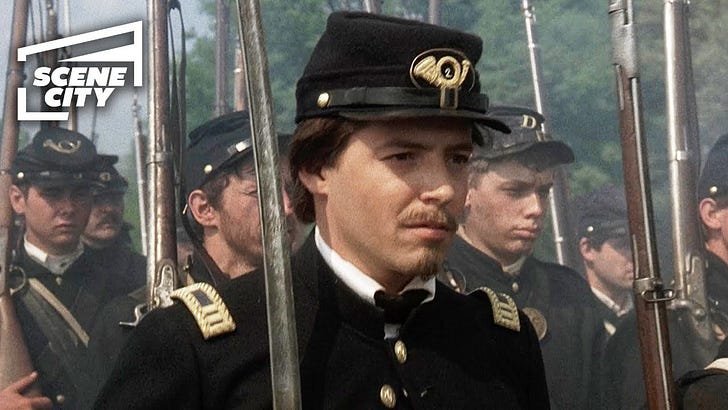
I love the opening scene of the movie Glory. It’s really the only moment in the film that covers Robert Gould Shaw’s military career prior to accepting the colonelcy of the 54th Massachusetts Regiment in early 1863.
The scene opens with then Captain Shaw of the 2nd Massachusetts Regiment marching along a road filled with fugitive slaves or “freedom seekers.” It’s an incredibly powerful and accurate depiction of what took place along countless roads throughout the South during the war. For many Union soldiers, this was their first experience traveling in the South and their first opportunity to interact with enslaved people and see for themselves the horrors of slavery.
Earlier this week I was asked if the letter that Shaw recites in this scene is accurate:
Dear Mother, I hope you are keeping well and not worrying too much about me. You mustn’t think that any of us are going to be killed, for they are collecting such a force here that an attack would be insane.
The Massachusetts men passed through here this morning. How grand it is to meet the men from all the states, east and west, ready to fight for their country, as the old fellows did in the Revolution. But this time, we must make it a whole country, for all who live here, so that all can speak.
Before this war began, many of my regiment had never seen a negro, and now the roads are choked with the dispossessed. We fight for men and women whose poetry is not yet written, but which will presently be as enviable and as renowned as any.
Last night, we heard of yet another defeat, but we are not disheartened. I am honored to be part of such a splendid company. They have made me captain, of which I am enormously proud. You would think it strange to see me giving orders to a hundred men, most of whom are older than I am.
Thank you for sending my volume of Emerson. His words come home to me like truth. “A deep man,” he says, “believes that the evil eye can wither, that the heart’s blessing can heal, and that love can overcome all odds.”
My dearest love to Father. Your son, Robert.
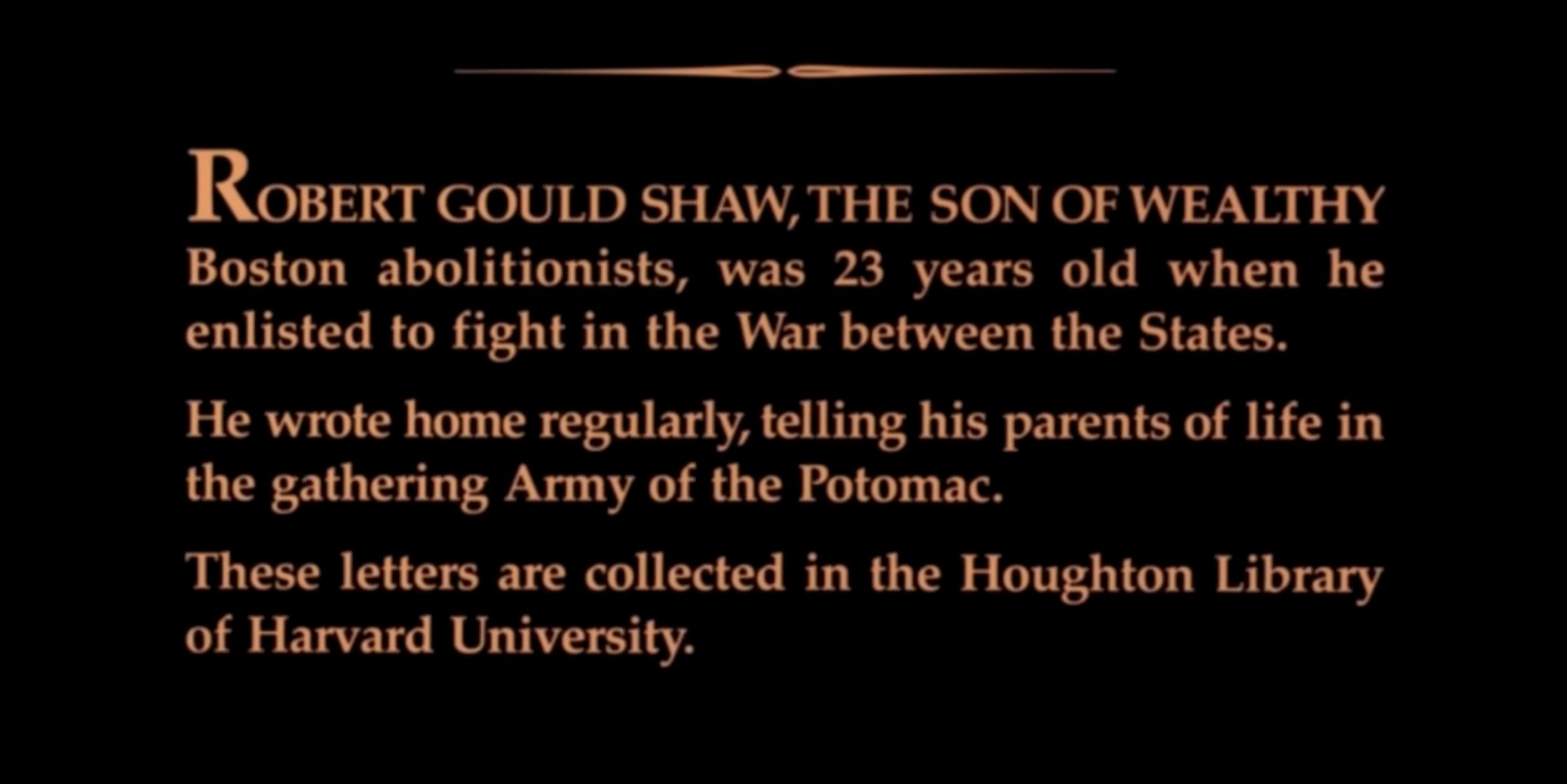
It’s confusing. The scene includes Shaw sitting at his desk writing a letter home to his mother and the movie opens with this still image indicating that many of the letters that Shaw wrote home are housed at Harvard’s Houghton Library, all of which is true.
The problem is that you will not find the above letter in their collection or in the published collection of Shaw’s letters edited by Russell Duncan. The letter is a fiction created by the scriptwriter specifically for the movie. As far as I know, Shaw never requested anything written by Ralph Waldo Emerson to be sent to him. He did share his excitement meeting men from other parts of the country during his 1-month deployment in Washington, D.C., in the spring of 1861, with the 7th New York Militia.
And while with the 2nd Massachusetts Shaw did write about his interactions with fugitive slaves along Virginia and Maryland roads, but that is all you will find that resonates with the letter above.
AI technology only makes things worse. Here is the result you will get if you ask, “Did Robert Gould Shaw say, “We fight for men and women whose poetry is not yet written?”
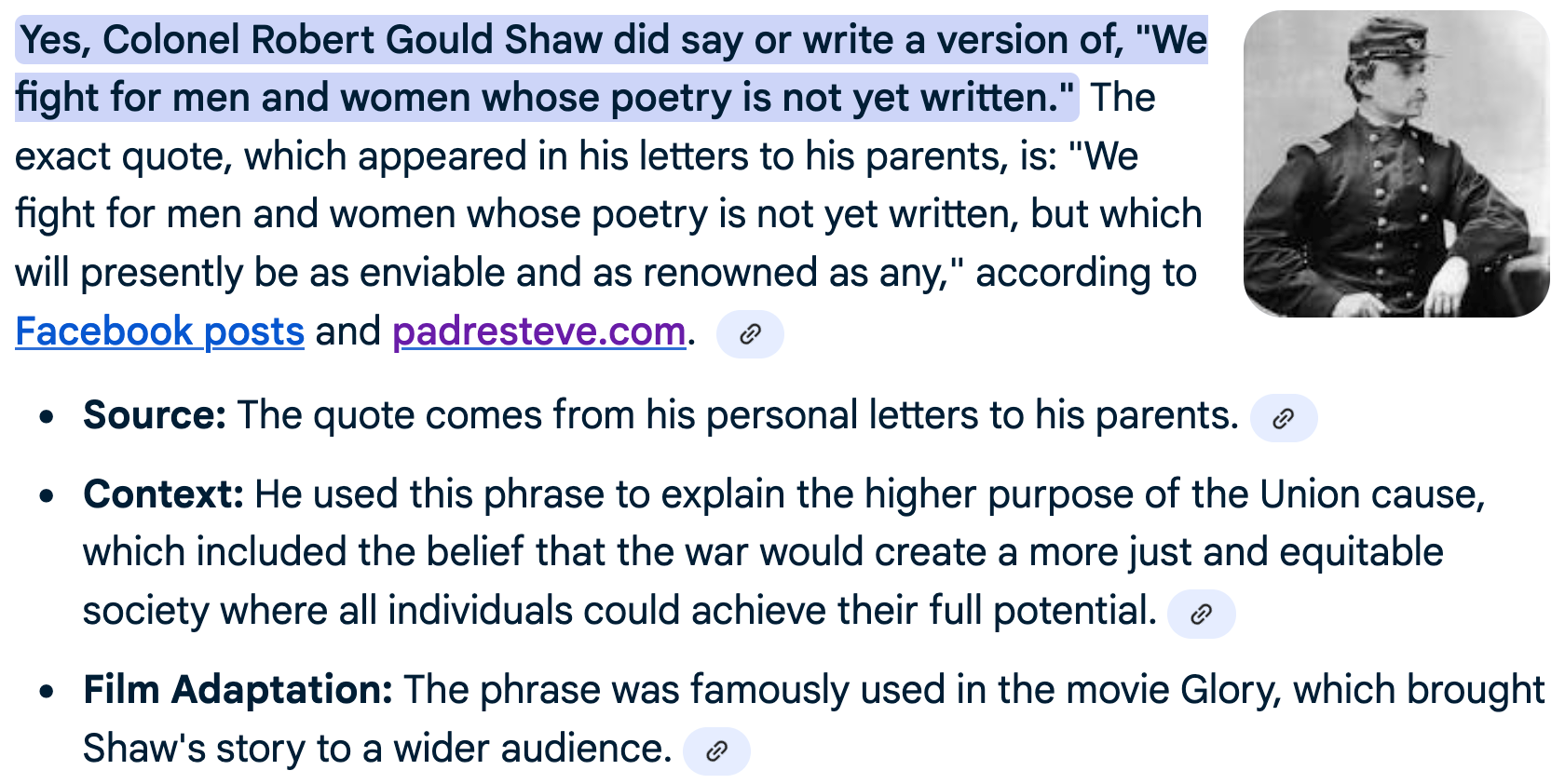
Of course, AI’s results are based on what it finds across the Internet. It does next to nothing to evaluate the veracity of individual websites and the content contained therein. To that extent, AI highlights a problem that has always plagued the study of history online. Most people think very little about the keywords used to search online for historical information and they do even less in evaluating search results.
You will find next to nothing in Shaw’s wartime correspondence that reflects the thoughts about slavery and the purpose of the war in the above fictional letter. Shaw came into contact with hundreds of enslaved people during his time with the 2nd Massachusetts in Virginia and Maryland, but that had little, if any, impact on his view of the war. Much of what he had to say about African Americans was laced with racist references and a paternalism that was typical of elite Northern men like Shaw.
Early in the war, Shaw was preoccupied with issues like discipline among the rank and file and especially in securing a promotion in rank.
Shaw remained consistent in this regard even after he accepted command of the 54th Massachusetts and transferred to the Sea Islands off the coast of South Carolina and Georgia.
What stands out in his correspondence with his abolitionist parents back on Staten Island is the wide gulf between how they viewed the war and Shaw’s more pragmatic outlook on the war—one that surfaced numerous times, especially over the issue of emancipation.
Of course, all of this is thoroughly explored in my forthcoming biography of Shaw, A Glorious Fate: The Life and Legacy of Colonel Robert Gould Shaw, which will be out next year with The University of North Carolina Press.
A quick reminder that this coming Sunday, October 19 at 8PM EST the Civil War Memory Book Group will meet to discuss Longstreet: The Confederate General Who Defied the South by Elizabeth Varon.
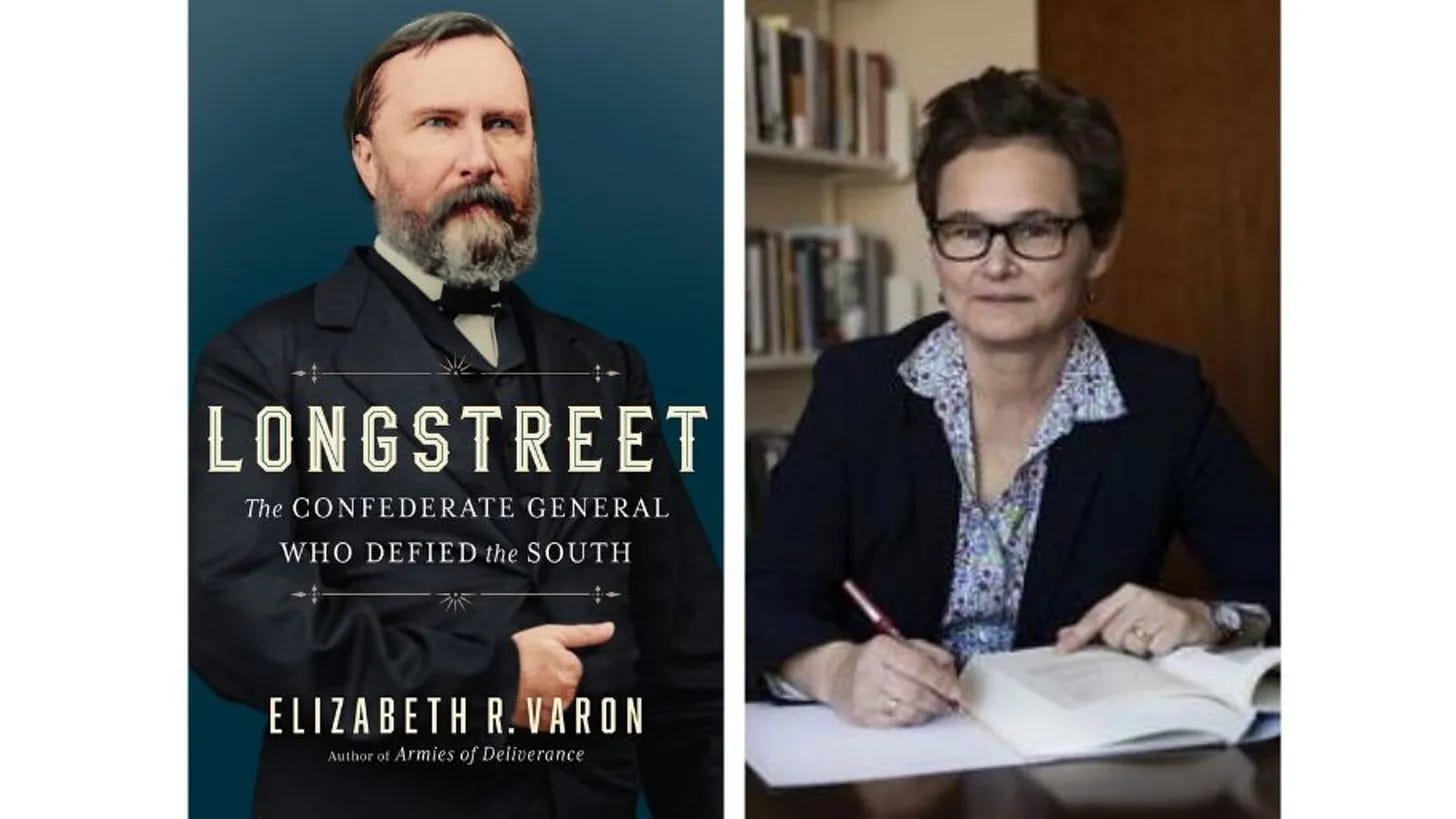
Dr. Varon will be joining us for this discussion, which will take place on Zoom. All PAID SUBSCRIBERS will receive an invite in advance of the meeting. There is still time to upgrade if you would like to join what promises to be a fun and engaging discussion.