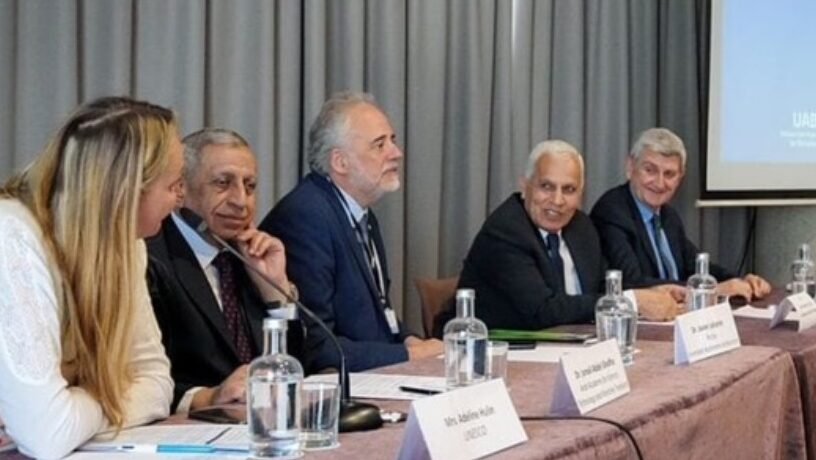
Shehata El-Sayed, founder of Cairo-based OshAi, tells TML: ‘The challenge now lies in transforming literacy from individual awareness into collective civic competence.’
As the lines between human judgment and machine intelligence blur (and often collide), UNESCO’s (United Nations Educational, Scientific and Cultural Organization) Global Media and Information Literacy Week—beginning Friday—takes on new urgency. This year’s theme explores how AI is transforming the way people consume, question, and trust information.
The flagship conference convenes Oct. 23–24 in Cartagena, Colombia, alongside global events marking the occasion.
Organizations across the Middle East and North Africa, including Saudi Arabia, Egypt, Iraq, Iran, and the Palestinian territories, are demonstrating a strong commitment to media literacy through a range of events and programs.
As social media grows and AI advances, understanding how to navigate information is more important than ever.
Shehata El-Sayed, founder of Cairo-based OshAi for Technology and Artificial Intelligence Industries, an initiative designed to help Arabic-speaking journalists use AI as a tool for verification, data analysis and the detection of disinformation, told The Media Line that digital literacy initiatives and awareness of misinformation have grown globally.
The speed, scale and sophistication of misinformation have outpaced these improvements
“However, the speed, scale and sophistication of misinformation have outpaced these improvements,” El-Sayed said.
El-Sayed, who has spent more than a decade in investigative journalism, created a platform, backed by UNESCO and IFRDT, to help educators and media professionals use AI tools to fight misinformation.
He explained that AI can be used to detect manipulated media, trace the origins of false claims, and map networks of coordinated inauthentic behavior. Though it may be used as a tool to combat misinformation, he also said it can exacerbate the problem through deepfakes, synthetic voices and AI-generated propaganda.
In addition to generating fake content, AI can also contribute to misinformation through algorithmic bias. If trained on data that reflect prejudices, AI systems can perpetuate stereotypes, he explained. In that vein, he also said women are disproportionately targeted by digital harassment, misrepresentation and deepfake imagery, and generative AI often reproduces gender biases.
The most significant drivers of misinformation are algorithmic amplification, political polarization and economic incentives behind viral content, El-Sayed explained.
He said social media platforms will often elevate divisive content to maximize engagement, which creates fertile ground for the spread of falsehoods.
In the MENA region, linguistic gaps in automated moderation, limited access to credible local journalism and the weaponization of digital narratives by state and nonstate actors compound these dynamics, El-Sayed explained. He also stressed that in the region, misinformation is not always overtly false but rather contextual manipulation of facts to mislead or serve ideological goals.
Although media literacy is not declining, he said it is not sufficiently institutionalized.
“The challenge now lies in transforming literacy from individual awareness into collective civic competence,” he said.
He calls for a multifaceted strategy to tackle digital misinformation—one that combines data literacy in schools with the use of AI verification tools in newsrooms. He also stresses that media literacy campaigns should be delivered in local dialects and that technology companies must build linguistic inclusivity into their platforms.
In Egypt and the broader MENA region, El-Sayed noted that though there is interest in media literacy education, it is often dependent on international partnerships rather than on national strategies.
Samy Tayie, the regional representative for Arab states in the UNESCO Media and Information Literacy Alliance, has spent more than 30 years advancing media and information literacy across Egypt and the Arab world. He told The Media Line that while the organization has offered teachers and media professionals extensive training and resources, those efforts have achieved only limited success.
Tayie says the alliance now focuses its efforts at the grassroots level.
“We tried with the teachers, we tried with media professionals, but the success was very limited. So now we go directly to people, and especially younger people,” he said.
For the past nine months, he has served as lead consultant on a UNESCO-supported project in Jordan aimed at bringing media education into high schools. He said most Jordanian schools now offer a media education class, and he hopes to establish a similar program in Egypt.
Tayie helped establish the Media and Information Literacy and Global Understanding: Peace for All conference in 2024, which saw delegates from nearly 30 countries. Its third will be held in Cairo in April 2026.
“I think that was, or it is still, one of the most important contributions which the Arab chapter has achieved so far,” he said.
In keeping with the AI theme, the Saudi Data and AI Authority, in collaboration with the International Center for Artificial Intelligence Research and Ethics, has organized an event titled “Deepfakes: Responsible Use and Social Risks.”
UNESCO’s Ramallah office and the Palestinian Ministry of Education and Higher Education are holding Global MIL Week activities, including training sessions and workshops on various topics such as digital safety, psychological wellbeing in the media sphere, and artificial intelligence, as well as other programs, initiatives and broadcasts, Hala Tannous, executive assistant and communication and information focal point for the UNESCO Ramallah office, told The Media Line.
Not every country should take whatever UNESCO is telling them to take … We have a lot of cultural diversity. So what is one man’s meat is another man’s poison.
Observed from Oct. 27 to 31 is US Media Literacy Week, founded by the National Association for Media Literacy Education (NAMLE). Donnell Probst, interim executive director of NAMLE, told The Media Line that many countries have their own version of a media literacy week around UNESCO’s Global MIL Week.
“Everybody really focuses on their specific country and what they’re doing within that country,” she said.
Tayie emphasized that media and information literacy frameworks vary according to cultural context.
“Not every country should take whatever UNESCO is telling them to take … We have a lot of cultural diversity. So what is one man’s meat is another man’s poison,” he said.
Probst noted that the unique challenge in the US is its size and lack of centralized education. She also said the US government does not make media literacy a national priority.
“[Media literacy] is really very much a grassroots effort, and it’s happening very differently from state to state and even city to city,” she said.
Probst added that the biggest challenge in the US today is how media literacy is communicated, noting that there is still little agreement on what the term actually means.
“Some people think that it’s trying to tell kids what to think, which is not what we do,” she said, noting media literacy is a process of critical thinking about content being consumed and created.
With AI, Probst explained, the challenge is its pace of advancement, which is faster than other technologies, as well as the low barriers to entry and ease of access.
“Education by default is very slow and often does not keep up with the pace of technology,” she said. “Seeing something that is changing and growing so rapidly is a much bigger challenge than I think what we’ve seen in the past.”
However, she also recognized the opportunity for AI to be used as a tool.
“We definitely don’t feel like any technology or tool is inherently terrible … There are always ways that they can be used for positive,” she said.
Despite its potential for positive use, such as recognizing fake content, she emphasized that media literacy cannot be replaced by AI.
I think something that we often miss from the conversation is that whether intentionally or unintentionally, the reason that misinformation spreads is because of people
Probst attributes the spread of misinformation to a very simple source: “I think something that we often miss from the conversation is that whether intentionally or unintentionally, the reason that misinformation spreads is because of people,” she said.
Though she recognized the role of algorithms and other technological factors in the proliferation of misinformation, she explained that human involvement in creating, sharing and recycling information — and neglecting to fact-check — contributes to the spread of falsehoods.
Though the rapid progression of AI presents risks, Probst said media literacy is not reliant on the medium.
“That process is the same, regardless of the technology, which is kind of the beauty of media literacy,” she said.
She noted that asking simple questions about authorship and intent and how the content is financed contributes to media literacy. Personal biases, which everyone has, can also warp how information is perceived, she explained.
She said media literacy is advancing in the US, particularly among younger generations, who have grown up surrounded by media and are more conscious of how they use it.
In Arab countries, Tayie said young people are becoming addicted to social media and are not being controlled by their parents. He views this issue as specific to the region, with children as young as 7 or 8 receiving phones, he said. In Egypt, he said, the phone ownership rate is 120 percent.
He stressed the importance of giving parents the tools and confidence to guide their children’s media use responsibly.
Social media is becoming a platform for hate speech, misinformation, and disinformation, and the situation is becoming worse with the development of AI, which can have either good or bad uses, he explained. More than just media literacy, he stressed the importance of digital literacy in general.
I think digital literacy will be the license which will help you to live
“I think digital literacy will be the license which will help you to live,” he said.
He also noted the tendency of social media to politicize religion, which he said helps the extremists and terrorists. He claimed, however, that in reality all religions promote peace and love.
Tayie noted that globally, media literacy has become a major goal, with the secretary-general of the UN in recent years calling on member states to adopt media education.
Though awareness of the problem is high, the need for media literacy continues to be critical. As AI and other technologies advance, proper education lags behind — but basic media literacy competencies remain just as essential.