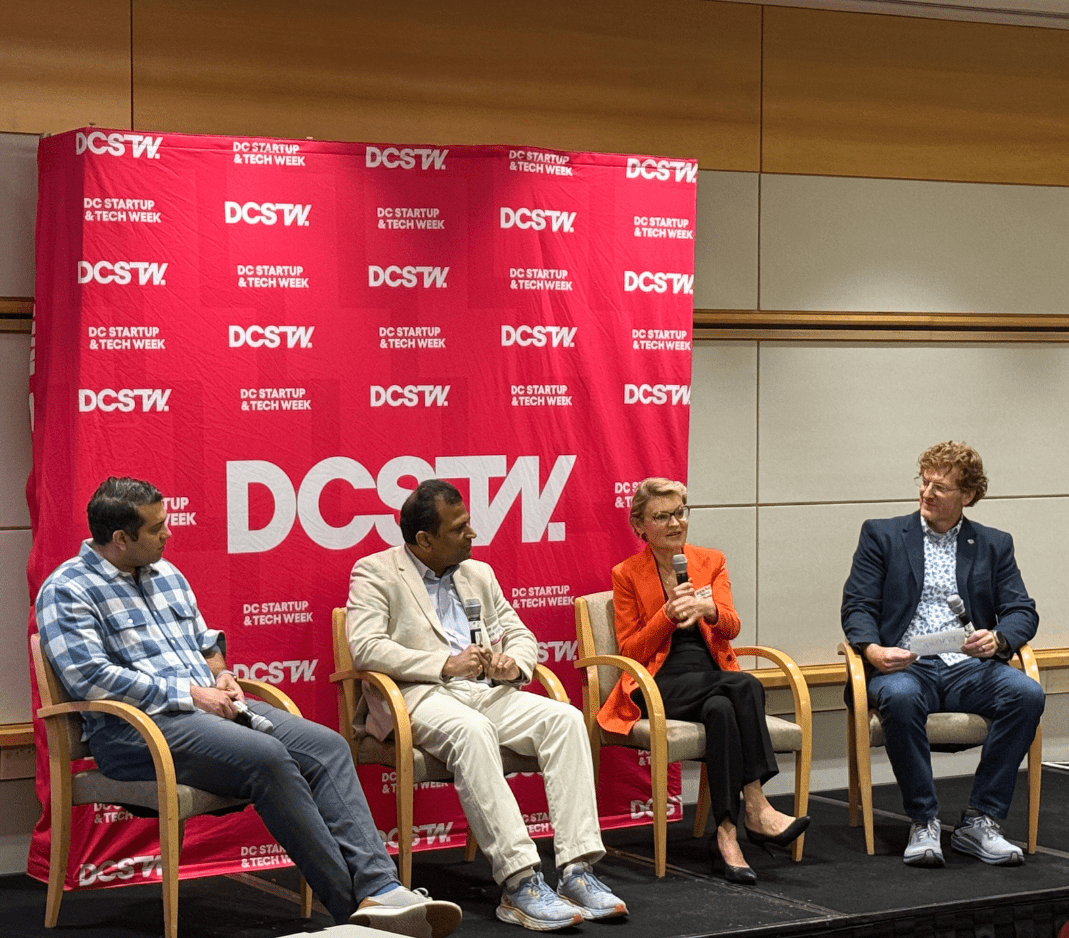
A recent roundtable at the DC Startup and Tech week, “AI, TechBio and the New Biopharma Playbook,” brought together four biotech and technology leaders explored how artificial intelligence is transforming discovery, development, and manufacturing—and what the next era of biopharma will really look like.
Moderated by Stephen M. Perry, founder and CEO of Kymanox, the conversation quickly made clear that this isn’t just another hype cycle. What’s emerging is a new operating model for life sciences—leaner, faster, and more connected—built around the intelligent integration of human insight and machine learning.
From the startup trenches to global regulatory halls, the message was consistent: AI isn’t replacing people or processes—it’s redefining them.
The TechBio Mindset: Where Speed Meets Substance
When Ajay Kori left e-commerce to co-found Novilla, he entered biotech with an unconventional perspective—and a deep sense of impostor syndrome. “I came in with a lot of insecurities,” he said. “We didn’t look like a traditional biotech company. We had fewer staff, a different structure, and everything ran through AI.”
What Kori discovered is that what once looked like weakness is actually a blueprint for the future. Novilla’s platform uses AI to discover “one-in-a-billion” molecular combinations that drive drugs directly to their site of action, dramatically increasing efficacy and reducing side effects.
“Typical biotechs with a lead asset entering Phase II have raised $75 million and have about 100 employees,” he noted. “We’ve raised $20 million and have nine. Our algorithms take us from idea to preclinical in weeks instead of years.”
That shift—from manpower to compute power—defines the TechBio ethos. As Perry summarized, “Entrepreneurialism forces you to be scrappy. AI is now amplifying that.”
AI as the Accelerator: From Lab to Clinic to Manufacturing Floor
If Kori represents AI’s promise at the front end of discovery, Harsha Rajasimha, founder and CEO of Jeeva Clinical Trials, is focused on what happens once drugs enter the clinic.
Rajasimha, whose company builds platforms to make trials more accessible and patient-centric, argues that AI is beginning to move faster than science and business can keep up with. “For the first time, AI is ahead of the process,” he said. “We can now configure a clinical trial protocol in two weeks—and soon in two hours.”
Still, he warns against overpromising. “You can’t take a nine-year clinical development cycle and make it three,” he said. Instead, the focus should be on targeted acceleration—using AI to map every step of the process, identify inefficiencies, and make participation easier for patients.
His team’s work reflects a broader industry shift toward decentralized and human-centric clinical models, where flexibility and inclusion are just as important as speed. “AI can’t replace the human side,” he said. “It should reduce the burden on coordinators and investigators so we can focus on quality, data integrity, and patient experience.”
On the manufacturing side, Irene Rombel, CEO and co-founder of BioCurie, is applying AI to an entirely different problem: the crippling cost and complexity of producing advanced therapies.
“The bottleneck in genomic medicine isn’t discovery—it’s how to make and scale these therapies safely and cost-effectively,” she said. “We’re bringing the sexy back to advanced biomanufacturing.”
Her company uses AI combined with mechanistic modeling—a “first principles” approach grounded in biology, chemistry, and physics—to predict and optimize complex bioprocesses. “We can simulate millions of production runs, identify the optimal recipe, and do it transparently,” she explained. “The FDA likes that—it’s interpretable, not a black box.”
Beyond the Hype: The Rise of Applied AI
All four panelists agreed: AI’s current hype cycle echoes the dot-com era, where “pets.com billionaires” gave way to companies that actually built value. In biotech, too many AI-first drug discovery firms have overpromised and underdelivered.
“The ROI for AI in drug discovery hasn’t been great,” Rombel said. “Gazillions have gone into it, but results are still comparable to traditional methods. It’s still a ‘show me’ story.”
The shift now underway is toward Applied AI—focused, pragmatic use cases that improve quality, reduce cost, and deliver measurable ROI.
At BioCurie, that means using AI where it fits: augmenting mechanistic models with machine learning to make manufacturing more predictable. For Jeeva, it’s using AI to streamline trial operations, not make impossible leaps in patient recruitment. “People use ‘AI’ too glibly,” Rombel said. “It’s all about context of use.”
Perry distilled it neatly: “When you’re in a right-first-time, high-consequence situation, AI disappoints. But in low-consequence, high-volume tasks—like screening or simulation—it performs beautifully.”
Humans Still at the Center
Despite their technological focus, all agreed that the future of biotech will remain deeply human.
“AI isn’t going to replace scientists,” Rombel said. “But scientists using AI will replace those who don’t.”
That mindset is shaping a new kind of workforce. “Every part of the business—operational, administrative, strategic—can leverage AI,” said Rajasimha. “But it’s still people-centric and patient-centric.”
For Kori, once skeptical about AI’s impact on humanity, the personal experience of using AI tools changed his view. “I was afraid AI would take jobs or purpose away,” he admitted. “Now I see it just makes our lives better—it helps us build better therapies and spend more time with our families.”
Regulation, Reality, and the Road Ahead
Even the FDA—long seen as a barrier to innovation—is shifting gears. “It feels like we have a brand-new FDA,” said Rajasimha. “They’re using AI internally for regulatory review and are very pro-AI. Now it’s up to industry to catch up.”
Rombel pointed to the agency’s draft guidance on AI-driven decision-making as a critical sign of progress. “They’re not fans of black box models,” she said. “They want validation, lifecycle management, and interpretability. That’s how you build trust.”
The roundtable ended where it began—with optimism grounded in realism. “We’re not wearing rose-tinted glasses,” Rombel said. “We know the limitations, but we’re bullish on what’s possible.”
In Perry’s closing words: “The leaders in this space aren’t dreamers or wanderers—they’re connectors. They see across discovery, clinical, manufacturing, and regulation. AI doesn’t erase the human element—it rewards those who know how to link it all together.”
The New Playbook: Lean, Interdisciplinary, and Human-AI Hybrid
The new biopharma playbook emerging from this conversation is clear. The next generation of life science companies will:
- Run leaner and smarter, using AI to replace friction, not people.
- Integrate across disciplines, combining tech agility with deep biological insight.
- Focus on applied impact, not hype, building trust through transparency and interpretability.
- Empower the human element, where talent and technology amplify each other.
TechBio isn’t a new buzzword—it’s a paradigm shift. As Perry said, “It’s a beautiful time to be alive.”