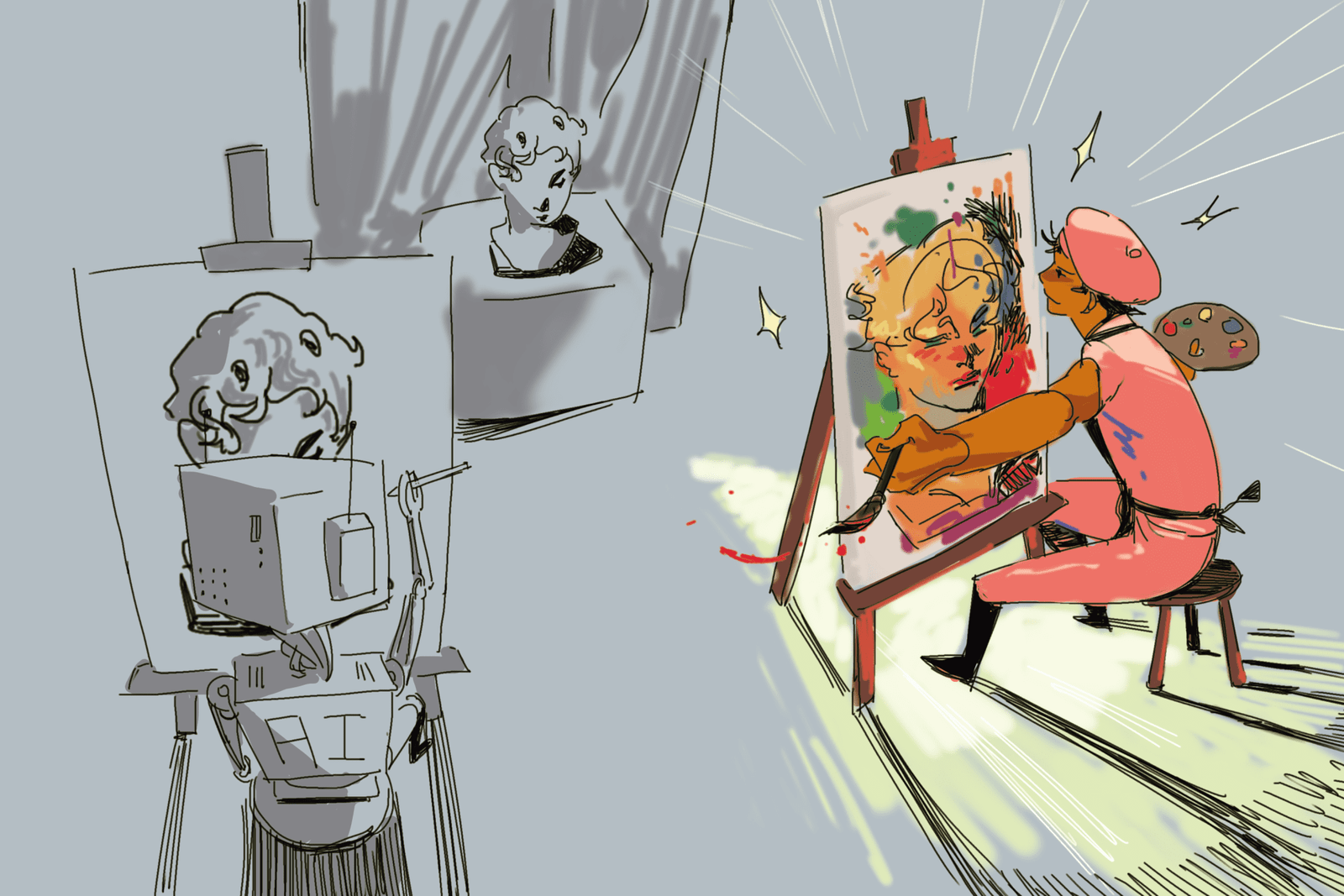

Undeniably, the expansion of artificial intelligence, or AI, has revolutionized the landscape of the professional world. Because of this, many students are questioning how they can compete with this rapid progression. However, there are still critical limits to the use of AI, such that the unique skills of students remain a necessity.
The current limits to AI are due to its underlying design. As a program, large language models, or LLMs, are a type of AI that is trained on large sets of text data to produce content. They run on a complex system of commands, which enables quick, efficient and thorough analysis and computation, but it lacks the ability to generate true originality.
The drawback of current AI is its fixed design. The fact that LLMs use already existing information to generate ideas and lack the ability to deduce information rationally means that, by definition, they are limited to producing from knowledge that already exists. However, true originality stems from going beyond pre-existing notions and becoming an outlier from typical thinking.
“Because LLMs are statistical averages of the texts that they were trained on, the question is how is it even possible for them to go outside of these averages that are (ideas) in common circulation?” said Daniel Drucker, assistant professor of philosophy.
It would be unfair to disregard AI’s capacity for originality entirely. By rearranging data, LLMs can produce innovative conclusions.
“So imagine that you have a very complex idea that is basically an assemblage of more simple ideas,” said John Bengson, professor of philosophy. “It might be very illuminating to put the simple ideas together in this complex way.”
Furthermore, future developments in artificial intelligence could overcome the limits set by its rule-based structure.
“You’re excluding the possibility that a computer of any kind can ever have a truly original idea,” Sarkar said. “I suspect in the long run AI can have algorithms that can (make us see beyond what any, even very bright, human being would be able to see), but we are far from there now.”
However, this does not account for current AI’s incapacity for authentic originality. Therefore, there are still specific skills that we have as humans that will be essential when collaborating with AI. Fascinatingly, agency may be a key contrast between humanity and AI.
“I think it’s about agency, … there’s something in humans where we push ourselves to do things,” Drucker said. “What I feel is lacking is not cognitive ability in the LLMs, it’s this drive.”
Fundamentally, our drive to go beyond common understanding, explore new ideas and push the boundaries of what is known is what separates us from AI. LLMs are trained to satisfy commands and then move on to the next, but humans have the willingness to persist.
Additionally, our capacity for interpersonal communication will be key to cooperating with LLMs. The skill of supportive communication is transferable to effective prompting.
“People noticed very early on that (the LLM) will produce better outputs and they will just do better if you speak to them like someone who’s successfully encouraging other humans to do a good job,” Drucker said. “I think understanding them and understanding how to speak to them in ways that are both relatable and alien is the thing that’s going to be most useful for people.”
Artificial intelligence will reshape major aspects of every industry. However, the essential human qualities of agency and communication will be critical throughout all of them.
Stark is a chemical engineering freshman from Orange County, California.