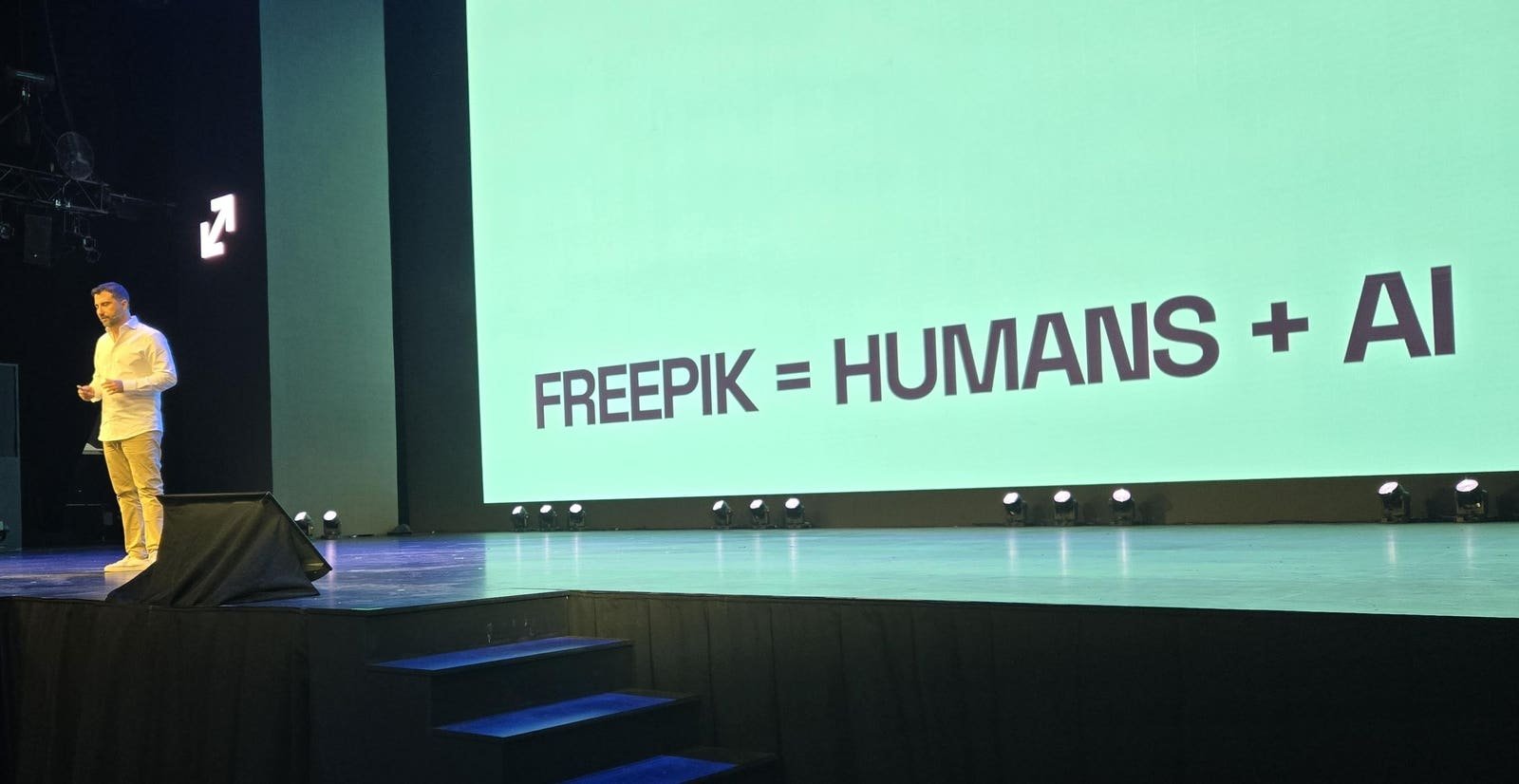

Joaquin Cuenca Abela, CEO of Freepik at the Upscale Conference 2025
Ron Schmelzer
Freepik CEO Joaquin Cuenca Abela wants creative teams to share their processes. Not just the final outputs, but also the steps. Cuenca argues that progress in AI design will come from exposing processes and letting teams collaborate and replay, as opposed to the “slot machine” that results in today’s outputs, as he puts it.
Freepik’s bet is their new Spaces offering, a shared workflow board where people can wire together image and video outputs in a node style interface. This allows for rapid iteration of multistep processes and also allows saved workflows to be run again with different inputs.
“We wanted to show the thought process that goes when we create something, all the storyboarding, all the rejected ideas,” Cuenca told the Upscale Conference audience. “At this company, we believe in you, we believe in human uniqueness.”
The Move From Solo Generation to Process
Teams struggle to pick up where a colleague left off when it comes to multi-step generative AI processes. Cuenca saw it inside Freepik’s own walls. Designers chained long sequences of actions to get to a good quality output, but when posed with the challenge of reproducing that output, they forgot the exact path.
“Sometimes they were not able to remember the whole sequence,” Cuenca said. “We were not able to make them again exactly as they were done the first time.”
To respond to this need, Spaces presents a board and a graph. Steps sit in the open. Inputs sit up front. Reuse and iterating tweaking is part of the flow. A shared canvas reduces black-box behavior. Teams can say why something changed, not just that it did. Reproducibility helps budgets and brand reviews. Reuse helps regional work and seasonal refreshes. Cuenca’s example of rebuilding a sequence by swapping characters makes that concrete.
For example, Freepik demos a short video output wired together in the board. The flow allows users to interactively swap the two characters. Then users can re-execute the chain and get a new cut with the flow intact.
Creative work improves when more people touch it, says Cuenca, “No creativity happens in a vacuum.” AI sessions live in one person’s head, which keeps team size small and storytelling brittle. Spaces invites the team back in with transparency, permissioned sharing, and simple gates that expose only safe inputs to non-experts.
An operating layer over many models
Freepik chose orchestration over building a single foundation model. The company offers a wrapper across a variety of available models. “We build a layer on top of the models that help people use those models and get the best of them,” Cuenca said.
Freepik is not the only ones building node-style flows for image and video generation. ComfyUI popularized node graphs for Stable Diffusion, where creators trade workflows as much as outputs. Runway markets custom node-based chains across modes for video. Outside of image and video generation specifics, workflow tools from N8N, Make, and Zapier also offer node-based workflow tools.
Adobe also announced recent updates to keep widening the tent. Adobe Firefly now works alongside engines from OpenAI and Google, with new features rolling into Creative Cloud and Firefly Boards. Canva is also expanding its AI and workflow capabilities with Magic Studio.
Unlike the generic workflow tools, Freepik Spaces orients around creative steps, previews, and repeatable flows on a canvas board built for creative process rather than app wiring. Cuenca expects power users to ship flows like products, complete with input gates, while less technical teammates reuse them without touching the wiring. He even hints at a marketplace dynamic.
In addition to the built-in models, Freepik announced a version for Enterprise buyers that ask for “bring your own model.” This includes custom trained versions, or models with data locked to private endpoints. The company is exploring further expansion to their enterprise strategy with API-key integrations.
A Shift for the Creative Industry
Freepik reshaped itself in the past two years. Originally a stock marketplace, the company has expanded to be an AI-centric platform. The company has expanded its acquisition channels. The company now has over 400 employees, and its big in-house art team doubles as a testing group. The company is still primarily bootstrapped, running on profits, and Cuenca insists that the company isn’t seeking funding or acquisition partners, but leaves the door open to opportunities for speed when the growth curve looks right.
“We have been operating this company in a profitable way since we started,” Cuenca said. Growth comes, he argues, when teams get repeatable outcomes and ask for more of them.
Cuenca also sees the emergence of a new role in the organization called the “creative engineer”. Combining right-brained creative talent with technical engineering skills, the creative engineer is part producer, part technologist. This role would be responsible for wiring models together and designing how the work runs. If that job scales, a flow marketplace will become a hotly contested, competitive market.
And for sure, the competitive landscape is heating up. Cuenca calls AI the most crowded industry he has seen. What sets Freepik apart from some of the larger hyperscalers is that the company is not betting on a single constantly-evolving model or set of models. It is betting on how people work together with many of them. Spaces puts the process on the table, where colleagues can read it, run it, and iterate on it.
Cuenca’s closing line at the conference summed up the stance. “Please stay unique, be interesting.” That applies to both the users of the product and the company itself.