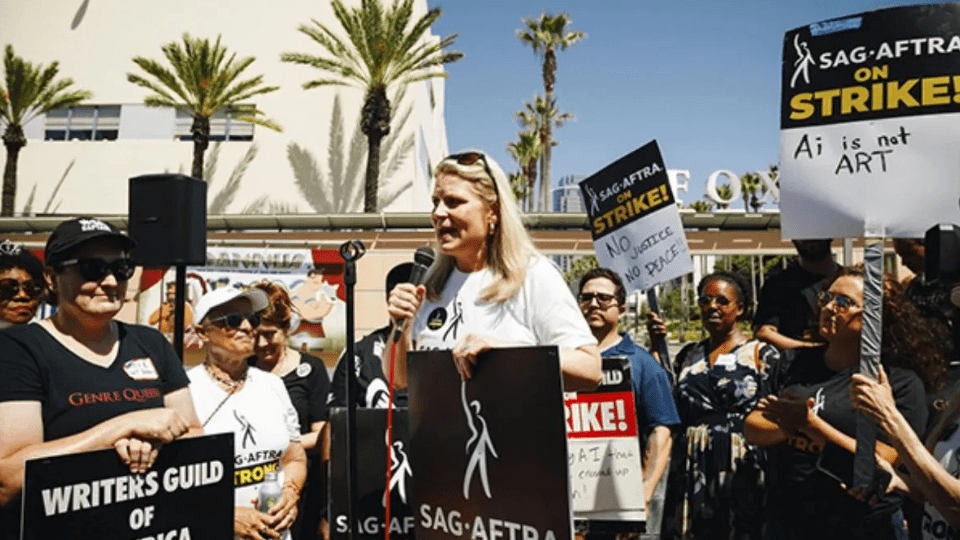

A major issue in last year’s SAG-AFTRA strike was how AI can be used to destroy art. Liz Shuler, president of the AFL-CIO, was deeply involved in that fight.| Photo via atulocals.org
WASHINGTON —A union contract can be a valuable protection for workers against corporate executives bent on replacing their brains and skills with responses generated by artificial intelligence, AFL-CIO President Liz Shuler says.
The catch, however, is to both contract for those protections and to erect strong guardrails—including massive legal penalties–for misuse of artificial intelligence (AI). And to turn AI to workers’ advantage. That would also be to the companies’ advantage, by making jobs easier for workers and to in turn, improving productivity for the firms.
Shuler made those points as part of a panel discussion at Georgetown University on October 30, covering “Poverty, work, and artificial intelligence.” But the panelists also delved into a recent pro-worker teaching document by new Pope Leo XIV. That document in turn elaborated on the Chicago-born pope’s remarks to a group of Chicago Catholics at a private audience in October.
The artificial intelligence threat looms large over the future of work, panelists agreed, and recent large layoffs at Amazon, UPS, and other companies appear to bear that out.
More than two years ago, AFL-CIO Secretary-Treasurer Fred Redmond forecast the perils of AI. He predicted it could let firms make millions of workers redundant—or unnecessary—and that society must confront that potential disruption.
“The AI revolution has the potential to unleash broad-based prosperity that improves working conditions and lifts us all up. But if left unchecked, AI can increase economic inequality and undermine job security,” Redmond warned then.
“An estimated 300 million jobs are at risk of automation by AI” worldwide, “including nearly half of all jobs in the United States.”
Shuler told the panel and the audience at Georgetown University about her recent, and chilling, visit to a conference in Silicon Valley—and how CEOs there approached AI.
In Silicon Valley, the sole objective on CEOs’ minds was how to use AI in the service of corporate greed, enhancing revenues and profits.
“There were a lot of people there who are ready to unleash AI to, putting it simply, to make more money and to exacerbate inequality,” Shuler said.
That’s not where the AFL-CIO is headed in the current capitalist system, which emphasizes return on investment in the short term at the expense of workers, communities, quality of life, liberty, democracy, and jobs. “We’re not anti-technology in the labor movement,” Shuler said. She added that AI can be made to work for workers rather than destroy their jobs. “What we are is anti-greed,” she said to applause.
“We’re going to need everyone to put up guardrails to make sure the AI future is human-centered.”
Recent AI-produced mass layoffs, right now mostly of middle managers, at Amazon, UPS, Starbucks, and elsewhere, show AI isn’t human-centered, at least not yet. And it won’t be without guardrails.
“There’ll be so much change so fast that workers will not be able to keep up with it” on their own, Shuler admitted. “There’s no worker they will not touch” with the changes AI brings.
Workers would wind up being jobless, and poor. How to lift up the poor was the other theme of the Georgetown University session, discussing Pope Leo XIV’s recent education document declaring that respecting, learning from, and lifting the poor, including by unionization, must be central to Catholic social teaching and thought.
“With the total transformation of the economy and of artificial intelligence, income inequality is greater than it has ever been,” Shuler added in discussing Leo’s stand. The threat to workers is even larger overall, Shuler added, due to political “attacks on immigrants and vulnerable workers.”
“We appreciate the direction the Pope has taken,” in their defense, she said.
That’s where the union contract enters the picture, Shuler said. That’s also where Pope Leo entered the fray with his teaching document for Catholic leaders and parishioners, other panelists said. That document discussed using AI as a tool to fight poverty and praised the role of unions in doing so.
Indeed, the other panelists said Pope Leo deliberately chose that papal name, which hadn’t been used in more than a century, to make clear he follows the footsteps of that pope, Leo XIII.
Pope Leo XIII issued the encyclical, which put the church firmly and openly on the side of workers and unions, embedded in Catholic Social Teaching and thought.
“When workers come together collectively and are able to organize, at scale, to train at scale, to build and balance to scales at scale, that’s what we believe moves this country forward,” Shuler said.
Shuler’s remarks came a week after the AFL-CIO issued a comprehensive agenda of principles for how workers, unions, and the federation should address AI. Besides the primacy of collective bargaining, its elements included:
Workers must “have economic security, knowing companies and public agencies must follow rules to make sure technology such as artificial intelligence (AI) is used safely, responsibly, and fairly. These rules put people first, and include worker input in the research and development process, during development and deployment, and at the collective bargaining table where they negotiate protections with employers.
“There is accountability with meaningful enforcement so employers think twice before designing or using AI systems that hurt workers or communities…With workers having a real voice in technology, AI strengthens, rather than weakens, democratic institutions, creating an economy that benefits everyone and ensuring public services are not undermined by improper uses AI should be about benefiting everyone, not just tech billionaires and corporate shareholders.”
That’s not happening now, the federation’s statement said.
“We are already seeing AI algorithms being used to determine who is qualified for a job, who is worthy enough for additional medical care, and who can afford to buy a home and where.”
“New AI-powered technology (is) being unleashed on all of us, much of it unregulated and some of it dangerous. Without commonsense rules and a true commitment to boosting worker voice, there is a different future where good jobs, working conditions, safety, economic security, and worker and civil rights are at risk.”
Other specifics in the analysis, at www.aflcio.org/principlestoprotectworkers, included:
- Elected officials are dithering, and some don’t want to regulate AI at all. Instead, the federation said, they’re “trusting AI developers—many of them the world’s largest technology companies —to act responsibly when we know they are failing to protect people from harm…Doing nothing, as Big Tech special interests would recommend, is a choice—the wrong choice.”
- “If AI does lead to job disruption or displacement, there must be proper advanced notice of a reduction in jobs or job functions, meaningful reemployment and income support, and effective training and retraining. Technological change must never be shoved down the throats of a workforce or used to undermine” worker rights.
- “Strong enforcement of labor rights is also essential to prevent AI from being used as a union-busting tool, undermining workers’ rights. It is critical that protection be in place to stop employers from weaponizing AI systems to undermine workers’ right to organize.
“When private sector employers use AI that harms workers, they are placing profit over the interests of people. When public agencies deploy AI hastily without asking tough questions and ensuring the public is protected, people and services suffer. AI can be used to monitor, evaluate, and control workers, often without workers even knowing about it,” including in AI systems which “carry out dangerous experimentation with unsafe and unproven automation.”
- Workers must have whistleblower protections, too, to be able to speak out about AI abuses and exploitation without fear of retribution.
- Copyright and intellectual property protections are needed so firms cannot endlessly use a worker’s image, voice, likeness, traits, and even views of the body without the worker’s permission and without paying for repeated usage.
AI was the toughest issue in SAG-AFTRA’s long strike against streaming video, Hollywood, TV, and social media firms. Regulating its harms is a key cause of the Theatrical and Stage Employees, too.
- “Develop worker-centered workforce development and training,” both to retrain current workers in how to benefit from AI—the point of an academy which the Teachers/AFT are setting up, with tech firm cooperation, in lower Manhattan—and to train other workers who lose their jobs to AI in alternatives.
“Joint labor-management partnerships and union-centered, high-quality training programs, including Registered Apprenticeships, should be used when developing AI workforce training or digital literacy programs,” using union training centers, the AFL-CIO recommends.
- Workers know what’s needed on the shop floor, “better than a distant engineer, software developer or senior executive,” and they should set the pace, the federation said. “When governments use taxpayer dollars to fund AI research, workers and unions should be part of the process. Including them from the beginning helps to create more effective, safer technology and can help avoid bad decisions.”
- Mandate “transparency and accountability” in AI’s use “to prevent threats on people’s rights” including threats to civil rights and rights of workers in union contracts.
“Allowing an algorithm to secretly determine whether a worker should be hired, promoted, disciplined, or fired is a recipe for discrimination and unfairness, stress and job deterioration…Workers must also have the right to use their professional judgment, without retaliation, to override AI decisions, especially in safety-sensitive or even life-or-death situations.” And if AI companies harm workers by their use, there should be “significant financial penalties…meaningfully enforced.”
“AI systems may turbocharge bias and discrimination, making existing inequalities worse by using systems difficult to detect and challenge. When algorithmic decision-making systems exclude a person based on their race, gender, age, or disability or other protected characteristics, those uses violate their civil rights and must be barred” not just at work but in the wider society.
The AFL-CIO also condemned use of AI for creating “realistic content that may or may not be true” on the Internet, such as lies and deepfakes. That “undermines public trust and democracy,” including democratic elections and systems, the federation said. “There should be serious consequences for using technology to undermine democracy and civil rights.”
Speaking of content that may or may not be true, ChatGPT, a key source for artificial intelligence statements, still thinks Francis I, who died earlier this year, and whom Leo XIV succeeded, is the Pope, the National Catholic Register reports.
The Pope, born Robert Francis Prevost in the Chicago southern suburb of Dalton, spoke strongly in support of workers and unions in his talks with both the Chicago clerics and other attendees at a world conference the Vatican hosted, said two of the other Georgetown panelists, Cardinal Blaise Cupich of Chicago and Cecilia Flores, the executive director of the Catholic Volunteer Network.
“He wants to make sure there are preferential opportunities,” plus respect and attention paid, “to the poor,” the Cardinal said. “It’s not just a teaching, he said. It’s the heart of who we are: Don’t claim to be a holy person if you don’t have care for the poor.”
Flores agreed, but warned, “Catholic social teaching makes people in America very uncomfortable. He’s not teaching us anything new. He’s reminding us who we are. We have lost our way and he’s saying, ‘Hey, get it together.’”
That may be easier said than done. There have been quite a few instances over the years where Catholic-run institutions and individuals have deliberately turned their backs on workers, the poor, and Catholic social teaching. One big one was in Chicago: The board of the Catholic-run Resurrection Health Care hospital system spent years, and broke labor law while doing so, fighting off an organizing drive by AFSCME among the hospitals’ support staff.
And eight U.S. Catholic universities argued to the National Labor Relations Board that the U.S. Constitution’s 1st Amendment and its freedom of religion clause mean labor law doesn’t apply to them, so they could fire pro-union workers and suffer no penalties.
The universities weren’t battling an organizing drive among their professors—or even among professors of theology. They were battling the Service Employees’ organizing drive among their custodial personnel and other support staffers.
We hope you appreciated this article. At People’s World, we believe news and information should be free and accessible to all, but we need your help. Our journalism is free of corporate influence and paywalls because we are totally reader-supported. Only you, our readers and supporters, make this possible. If you enjoy reading People’s World and the stories we bring you, please support our work by donating or becoming a monthly sustainer today. Thank you!
CONTRIBUTOR