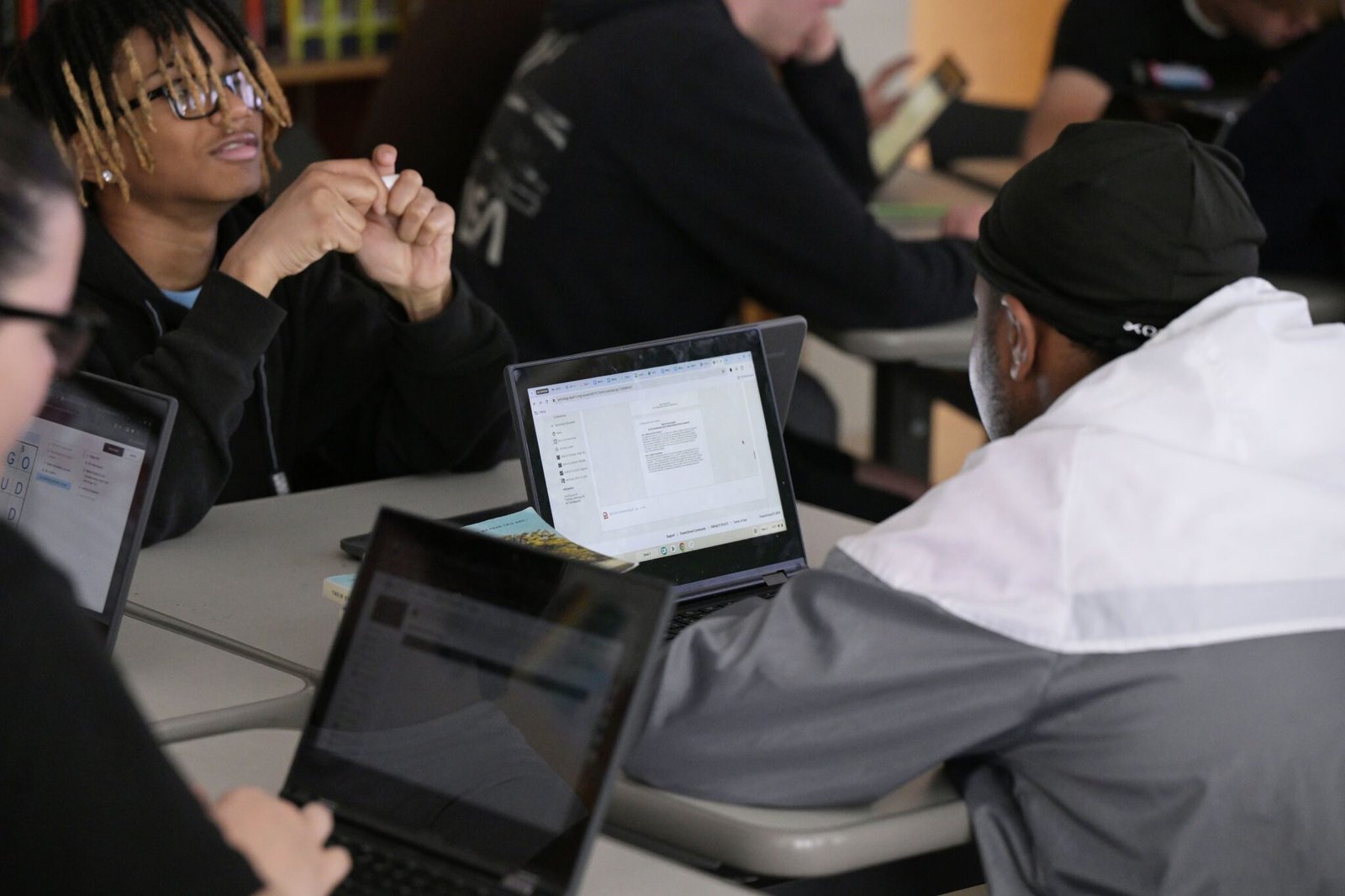

High school students in Denver use ChatGPT last year while discussing an essay for their English class. AI can be beneficial in some ways, but relying on it prevents students from thinking for themselves, Ashley Paredes writes.
My generation is letting artificial intelligence do the thinking — or too much of the thinking — for us.

As a teenager, I have seen friends and classmates lose the will to learn because they can “just use ChatGPT.” It seems like no one does their homework, writes an essay or studies for tests without using the assistance of at least one type of generative AI.
Article continues below this ad
I’ve seen friends freeze up when they run out of free uses on ChatGPT while using it for their math homework, leaving them unable to finish the problems themselves. I’ve seen them use multiple generative AI sites just to finish one homework assignment.
Now, don’t get me wrong, I think AI can be beneficial in some ways. I have used AI to help me brainstorm ideas for projects, and I have even used it to create an Instagram caption. But every time I use it, I wonder: Did I need help on this, or was I just being lazy?
AI is changing how my generation learns and connects. What’s even more alarming is when this technology is used for emotional advice. Rather than nourishing real friendships both in-person and online, many teenagers look to the internet for advice.
The current “loneliness epidemic” has been linked to this increase in social media use. According to the 2025 Life in Media Survey report, kids who post publicly on social media reported more mental health issues than those who did not. They reported higher rates of depression (54% versus 25%) and anxiety (50% versus 24%).
Article continues below this ad
As children lock themselves inside and reduce face-to-face interaction, they lose out on real friendships, which are crucial to adolescent development. According to a 2024 Common Sense Media Survey, 70% of teens report using generative AI, and 40% report using it for school assignments, with over half using it without their teachers’ permission.
Artificial Intelligence is still in early development, and there are flaws both in safety measures and accuracy. In the 2024 Common Sense Media Survey, about half of teens reported that they have double-checked with other sources to verify the accuracy of AI when used for school assignments. About 39% of teens have detected problems and inaccuracies in AI-generated outputs used for school assignments, while 25% reported that they are not sure.
These numbers are alarming as we have become dependent on these AI sources for almost everything.
But no one is willing to separate themselves from it. Our country isn’t doing enough to recognize the problem, instead investing more money in data processing centers. According to a report by McKinsey Quarterly, data centers are projected by 2030 to require $6.7 trillion in capital expenditures worldwide to handle AI processing loads.
Article continues below this ad
Rather than investing in our people, we are investing in technology that has been proven to harm the well-being of our youth. We have only seen this trend of deteriorating mental health grow and it will only continue to get worse if nobody regulates it.
As I do my next homework assignment, write my next essay and study for my next test, I will be doing so with all the power in my brain, not from a computer. Although this may not get me the grade I aim to receive, at least I know I will be learning.

Without a reliance on the internet, children can learn in schools and adults can learn to think for themselves. Although it may sound like the distant past, it was only a few years ago that people weren’t so reliant on generative AI. We can go back to it.
Article continues below this ad
Breaking free from AI dependence won’t be easy. But if my generation leads the way — choosing real learning and real friendships over easy answers — we can rediscover what it means to think for ourselves.
Ashley Paredes is a freshman in the journalism program at the University of Texas.