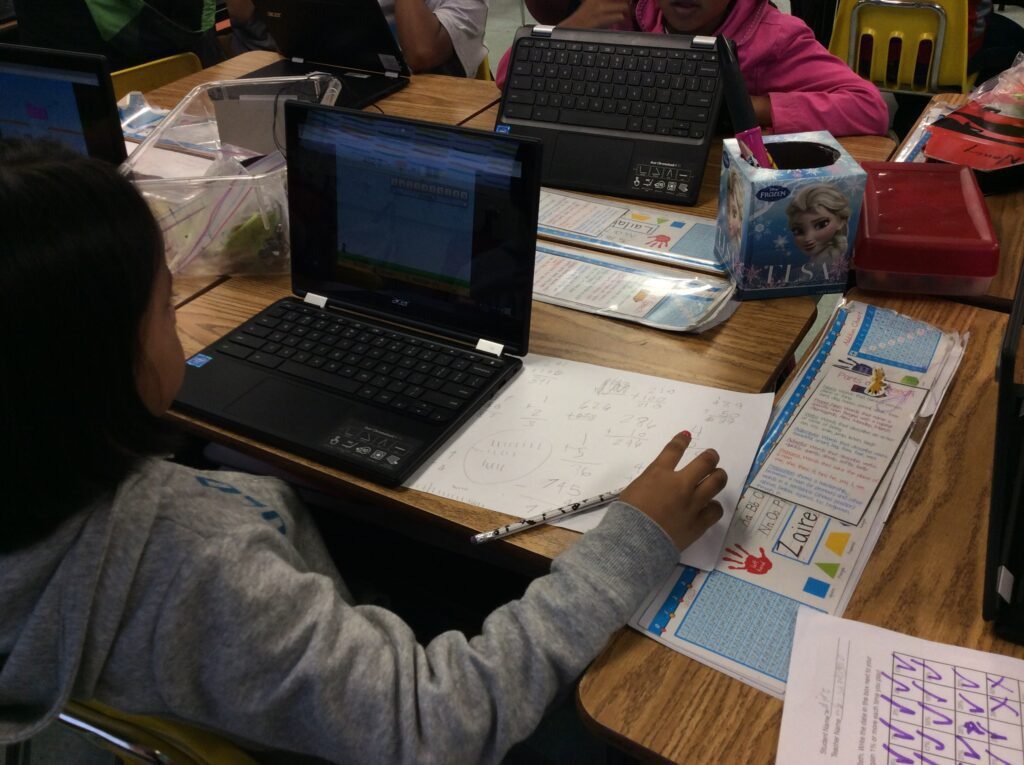

Allendale Elementary second-grader in Oakland Unified figures out puzzles in ST Math computer program.
EdSource File Photo
We are at a pivotal moment in education. Artificial intelligence (AI) is rapidly integrating into every aspect of our lives, including the classroom. According to the soon-to-be-published 2025 Teacher Landscape Report, 70% of computer science teachers are already teaching AI in their courses.
To prepare students for the future, we must equip them with the knowledge and skills to not only use AI but to be the architects of tomorrow’s AI-driven world. This is only possible with a foundational computer science (CS) education for every student delivered by prepared teachers and reinforced across subjects.
The current conversation around AI literacy in K-12 education is often focused on how teachers and students can use AI tools effectively. I am regularly asked: “If AI can write code, why take a computer science class?” AI will likely automate tasks in every field. The best way to prepare students for a rapidly evolving future is learning how AI works: the human role in creating AI, how computers represent and reason about the world, machine learning and data, ethical AI system design, and the social impacts of AI. These durable skills will help everyone from future electricians to nurses — and even software engineers — use and shape these tools.
Teaching students to simply craft better prompts or “vibe code” their business ideas is a failure of imagination.
In fact, we’ve tried this before. Over 20 years ago, schools across the country replaced computer science with courses focused on how to use word processor and spreadsheet applications — only to leave a generation left out of creating the technologies we rely on today. The skill of application use will quickly become obsolete and teach nothing about the foundational computational thinking skills that are central to problem-solving in the digital age.
Over the past two years, my organization, the Computer Science Teachers Association (CSTA), consulted experts in computing — from software engineers to education researchers — to identify the core, durable skills that will prepare students for a world powered by computing. The consensus is clear: A foundational computer science education is the cornerstone of AI literacy. We already have a growing movement of teachers across the country teaching these skills, and now is the moment for everyone to join this mission.
A survey of thousands of K-12 computer science teachers that we published in partnership with the Alliance for Interdisciplinary Innovation in Computing Education (AiiCE) revealed that 80% believe AI is a core part of the computer science curriculum. According to the State of Computer Science Report, 44 states have standards in place to teach these foundational skills, and a growing number require computer science for graduation. This current landscape is the perfect foundation for teaching students how AI works.
The challenge is clear: We must prepare every student to succeed in a world powered by computing. Let’s build on the success of the computer science movement and engage every educator and student to be creators, not just users, of AI.
•••
Jake Baskin is the executive director of the Computer Science Teachers Association, an educational organization focused on uniting and supporting K-12 computer science educators.
The opinions expressed in this commentary represent those of the author. EdSource welcomes commentaries representing diverse points of view. If you would like to submit a commentary, please review our guidelines and contact us.