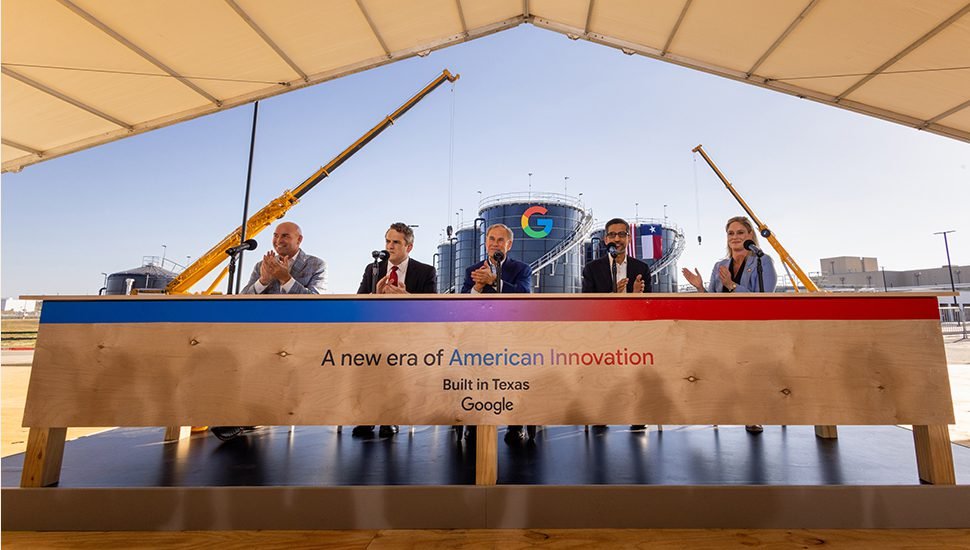
Google announced its largest-ever investment in any U.S. state on Friday, committing $40 billion to Texas through 2027 to add three new data center campuses and make the Lone Star State the centerpiece of its global AI data center footprint.
The announcement came at Google’s data center facility in Midlothian, where Alphabet and Google CEO Sundar Pichai joined Gov. Greg Abbott, U.S. Deputy Secretary of Energy James Danly, U.S. Rep. Jake Ellzey, and Amanda Peterson Corio, Google’s global head of data center energy.
“We are making a new $40 billion investment in the Lone Star State,” Pichai said at the event. “This includes plans for three new data center campuses, one in Armstrong County and two in Haskell County.”
The investment bundles cloud and artificial intelligence infrastructure, energy capacity initiatives, continued buildout in North Texas, and workforce training programs.
“This is a Texas-sized investment in the future of our great state,” Abbott said. “Texas is the epicenter of AI development, where companies can pair innovation with expanding energy. Google’s $40 billion investment makes Texas Google’s largest investment in any state in the country and supports energy efficiency and workforce development in our state.”
![Texas Governor Greg Abbott, left, and Alphabet and Google CEO Sundar Pichai at Google's Midlothian Data Center campus. [Photo: Office of the Governor]](data:image/gif;base64,R0lGODlhAQABAIAAAAAAAP///ywAAAAAAQABAAACAUwAOw==)
Texas Governor Greg Abbott, left, and Alphabet and Google CEO Sundar Pichai at Google’s Midlothian Data Center campus. [Photo: Office of the Governor]
Google makes Texas its AI infrastructure anchor
“Texas will be the centerpiece for AI data centers for Google,” said Abbott.
Pichai explained why Texas was selected for the massive investment. “Data centers of that scale require a few things: good, pro-innovation regulatory environments, land, and especially energy,” he said in Midlothian. “Happily, we found all three in Texas.”
Thanking Abbot for “leading the way,” Pichai added, “They say everything is bigger in Texas, and I think that applies to the golden opportunity with AI, the optimism, the talent, the policy environment, and the innovation needed to lead this new era and create immense benefits for everyone.”
The multi-billion-dollar investment will “create thousands of jobs, provide skills training to college students and electrical apprentices, and accelerate energy affordability initiatives throughout Texas,” he said.
The company, which currently operates two data center campuses in Ellis County, located in Midlothian and Red Oak, has maintained a Texas presence for more than 15 years, Pichai said, with thousands of employees across the state and offices in Dallas, Austin, and Houston.
Sunlight cuts across Google’s Midlothian, Texas data center campus during the announcement event, where CEO Sundar Pichai detailed its plan to bring more than 6,200 megawatts of new energy generation to the Texas grid and launch a statewide Energy Impact Fund beginning in 2026. [Photo: Dallas Innovates]
Net-positive power additions to the grid and Google’s “first industrial park”
Energy strategy emerged as a central theme of the announcement, with Google committing to be a net-positive contributor to the Texas grid as it builds out new AI infrastructure.
“When we invest in data centers, part of our core strategy is to invest significantly in new energy capacity, which increases supply and ensures grid abundance for everyone,” Pichai said from the podium. “In Texas, we work with local utility partners to add more than 6,200 megawatts of net new energy generation and capacity to the grid to keep costs low.”
According to Google’s news release, the company has power purchase agreements with energy developers such as AES Corporation, Enel North America, Clearway, ENGIE, Intersect, SB Energy, Ørsted, and X-Elio.
Abbott noted Google has provided a net new addition of five gigawatts of power to the Texas grid so far — and committed to be net positive to the power grid as the build continues, “making sure we have the reliability and the supply that Texas needs to keep the lights on for all of our fellow Texans.”
In terms of energy scale, 5 gigawatts is equivalent to 5,000 megawatts.
One of the new Haskell County data centers will be built directly alongside a new solar and battery energy storage plant. Pichai said Google’s first industrial park, developed through a partnership with Intersect Power, will be co-located at the Haskell data center. “Co-locating energy supply with data center load has some powerful benefits. It can unlock the development of new transmission infrastructure and optimize utilization of the existing grid,” he said.
Google announced its industrial park partnership with Intersect and TPG Rise Climate last year, described as a strategic collaboration to develop “powered land” to allow the data center to run mostly on carbon-free electricity produced nearby.
Cooling infrastructure at the Midlothian site—emblematic of the physical footprint behind AI—stood alongside Texas and U.S. flags as speakers detailed new data center campuses, grid-support commitments, and long-term investment in the region’s workforce. [Photo: Google]
U.S. Deputy Secretary of Energy on AI’s power demands
James Danly, the U.S. Deputy Secretary of Energy and the second-highest official at the Department of Energy, used the Midlothian announcement to zoom out to the national stakes of AI’s rising power needs.
“We’re going to need 100 gigawatts over the next number of years in order to satisfy the demand as we projected,” he said, noting the investment comes “at the same time as the President’s agenda focuses on ensuring safe, reliable, affordable, secure power for everybody, in abundance.”
In the company’s news release, Danly framed Google’s move as directly tied to that agenda. “This historic investment from Google advances this administration’s goal of winning the AI race,” he said in a statement. “Google is working to sustain and enhance America’s global AI dominance, economic competitiveness and national security while ensuring that energy remains reliable, affordable and secure.”
Danly also pointed to Texas policy as a key enabler of projects on this scale. “This is a state that has ensured energy abundance for everybody. It has made it possible to deploy new resources rapidly,” he said. “This is a model for how such projects should be done going forward, and the United States is going to be put in a very good position as a result of such projects.”
Pichai also tied the announcement to federal policy and thanked the administration. “We won’t be here without the leadership of President Trump and the White House AI action plan,” he said.
From left: U.S. Rep. Jake Ellzey and U.S. Deputy Secretary of Energy James Danly [Photo: Dallas Innovates]
‘We’ve known how great it is’
With the announcement just a few days after Veterans Day, U.S. Rep. Jake Ellzey opened his remarks by sharing Danly’s service record with the crowd. He reminded them that Danly went to Yale, joined the Army, and that the two men served in Iraq at the same time in 2006, where Danly was in combat and was awarded the Bronze Star and the Purple Heart.
Ellzey—a Republican representing Texas’ 6th Congressional District, including Midlothian and the surrounding area—kept his remarks close to home and tied the moment back to the people on stage.
“You’ve come a long way from Madras to Midlothian, and we’re glad that you’re here,” Ellzey told the Google CEO, noting that Pichai took over the company the same year Abbott became governor. “Who knew that today we would be talking about this $40 billion investment in Texas, but also in Midlothian. For many, many years, we’ve known how great it is, and now you guys are seeing it too.”
He also reminded the audience that Abbott’s own story runs through North Texas, pointing out that the governor is from nearby Duncanville and, as a high school senior, was voted “most likely to succeed.”
Ellzey then described the campus for those who hadn’t had a tour. About a year ago, he said, he walked through the buildings behind the stage and was struck by how familiar they felt. “I walked in and said, this looks exactly like an aircraft carrier,” he recalled.
When he asked who the workers were, he was told, “We were nuclear sailors in the United States,” adding that much of the technology is similar to that of a nuclear aircraft carrier. “So you have a very highly skilled, talented group of people working here.”
Insider the Midlothian facility [Photo: Google]
From there, Ellzey turned to how the project came together and the locals who helped land it.
The congressman named more than a dozen current and former Midlothian mayors and city council members, along with City Manager Chris Dick and others, for supporting the development. “This doesn’t happen without local leaders, citizens, and the employees of Alphabet and Google,” he said. “We all know Midlothian is a great place. Now the rest of the world knows too.”
Then he addressed a question on many minds: How do you power all this?
“A lot of people worry about these data centers. Where is the power going to come from?” he said. “We’re working together with the state, [with Google], and with the Secretary of Energy, to make sure that these places are powered on their own.”
Ellzey summed up what the investment means for residents in a statement released alongside the event. “Google’s investment here in Midlothian is a real boost for our community. It brings good jobs, new opportunities, and steady growth for families across our district,” he said. “Texas keeps showing why it’s the place to build and invest: low taxes, a strong workforce, and a can-do spirit you won’t find anywhere else.”
From left: U.S. Rep. Jake Ellzey, U.S. Deputy Secretary of Energy James Danly, Texas Gov. Greg Abbott, Google CEO Sundar Pichai, and Amanda Peterson Corio, Google’s global head of data center energy. [Photo: Dallas Innovates]
$30 million energy impact fund for affordability and energy workforce
Beyond the three new data centers, Pichai also announced a new $30 million Energy Impact Fund starting in 2026.
“This fund is designed to scale and accelerate energy affordability initiatives throughout Texas,” Pichai said. “For the next three years, starting in 2026, we’ll work with community partners and local organizations with a focus on energy costs, weatherization for homes and public schools, and building the energy workforce of the future.”
Google said it will establish a funding application process for community partners and local organizations.
In a news release, the company also detailed water and agriculture commitments tied to the expansion. Once complete, the three new facilities in Armstrong and Haskell counties will use advanced air-cooling technology, limiting water use to site operations such as kitchens, Google said.
Beyond its direct operations, Google is contributing $2.6 million to help Texas Water Trade create and enhance up to 1,000 acres of wetlands along the Trinity–San Jacinto Estuary and deliver approximately 300 million gallons of freshwater annually in southeastern Texas.
Additionally, Google said it is providing more than $2 million to support agriculture in Texas, including a regenerative agriculture program with Indigo Ag in the Dallas–Fort Worth area and an irrigation efficiency project with N-Drip in the Texas High Plains, according to the company.
CEO Sundar Pichai detailed Google’s comprehensive workforce development strategy, including apprenticeship programs for electricians and free AI training and career certificates for Texas college students across multiple universities. [Photo: Google]
AI Opportunity Fund: Training 1,700-plus electricians by 2030
The new AI and energy infrastructure will need trained people to build and maintain it, Pichai said.
Google’s workforce development strategy aims to increase the projected pipeline of new electricians in Texas by nearly 110%. “Our data center investments increase the need for electricians to help build that workforce pipeline,” Pichai said. “We are supporting the electrical training ALLIANCE (etA), which will train more than 1,700 new apprentices by 2030.”
That education effort will receive funding from Google.org’s AI Opportunity Fund, according to the company. The initiative aims to boost the number of apprentices in Texas, integrate AI tools into the training curriculum, and train both existing electrical workers and apprentices in the state.
“Our country, our world, is going to be hinged to electrons,” Abbott said. The engineers and electricians who will be getting this education, will be needed, “literally, for the rest of their lives,” he added.
Free AI training: Google AI for Education Accelerator
The workforce development builds on the work Google is doing with leading institutions in the state that help prepare students with critical AI and job ready skills, Pichai told attendees.
“We are giving Longhorns, Aggies, Bobcats, and many other Texas-based college students access to Google career certificates and AI training courses at no cost,” he said, adding there’s “no in-state rivalry here.”
According to Google, The University of Texas, Texas A&M, and Texas State University systems, along with Dallas College and South Texas College, are among the universities and colleges in the first cohort of the Google AI for Education Accelerator, giving students, faculty, and staff no-cost access to Google Career Certificates and AI training courses.
Google also committed $7 million in grants to support AI-related initiatives in healthcare, energy, and education across Texas. That includes helping CareMessage enhance rural healthcare access, enabling The University of Texas at Austin and Texas Tech University to address energy challenges, and expanding AI training for Texas educators and students through support to Houston Community College.
To date, Google said it has provided funding to local organizations that have trained more than 1 million residents in digital skills, the company said.
Thousands of construction and permanent jobs
Pichai said the company also supports “countless more jobs” across the state through its work with local businesses. The company’s investments and technologies helped provide more than $50 billion of activity for Texas businesses, nonprofits, publishers, creators, and developers in 2024, according to the company.
Google said it is continuing to invest in its existing Ellis County data centers in Midlothian and Red Oak, as it builds out its three new West Texas facilities. The company’s continued investment in Texas projects over many years will also support thousands of construction jobs, Pichai said.
“This project will do nothing but expand Texas’ lead nationally for new jobs,” Abbott said, noting the state’s continued number one rankings for the most new jobs, the best state for doing business, and the most economic development projects.
“We appreciate all the jobs that you’re bringing here, but equally appreciate the training, the high skilled level training is going to be needed to fulfill these jobs, he said.
Abbott also leaned into the idea of the state as a fast-moving partner.
“Texas is a partner with our businesses, large and small, and we will insist on continuing to move at the speed of business so that you will finish this project ahead of schedule and under budget,” Abbott said.
Texas Gov. Greg Abbott, Google CEO Sundar Pichai, and Google’s energy and global infrastructure expert Amanda Peterson Corio [Photo: Google]
AI powering everyday Texas businesses
Abbott moved the conversation from megawatts and megaprojects to everyday life.
“Some people are confused about what AI really does, and this term ‘hyperscalers,’” he said. “Your local McDonald’s is going to be using it to better enable their business to function. Your local stores, your local grocery stores, your local HEB, and things like that are all going to be operating better because of AI generated right here in the middle of Texas.”
Pichai connected the same dots from Google’s side of the house, tying the new infrastructure to services people already use.
“Data centers power the Google products people use every day: search, YouTube, maps, and the Gemini app,” he said. “And now they are powering an exciting new era of AI innovation that is leading scientific breakthroughs, including new cancer therapies and drug discoveries.”
Pichai also pointed to other Google-backed services expanding across the state.
“Waymo, the world’s first autonomous ridesharing service is available in Austin, and we plan to expand to Dallas next year. Our growing delivery service, Wing, and Walmart are completing thousands of deliveries each week in the Dallas area,” he said. “Our growing Dallas cloud region delivers high-performance, low-latency services to companies like NRG Energy.”
Google launched its Dallas Cloud Region in 2022 as part of a global network of 42 cloud regions that businesses and organizations use to build and scale AI-powered solutions.
Alphabet’s life science offshoot, Verily, also moved its headquarters from California to Dallas in 2024.
Google’s Sundar Pichai and Amanda Peterson Corio [Photo: Dallas Innovates]
Local officials embrace “generational investment”
Amanda Peterson Corio, Google’s global head of data center energy and a Texas native, told the audience that in her 10 years at the company, she’s seen how data center projects can affect communities like Midlothian and Red Oak.
Google has a “resolute strategy to ensure that Texas continues to lead the American Revolution,” she said, “through next generation, AI infrastructure, a robust energy and power market, and, most importantly, a future-ready talent pool.” She added that local leaders and community partners are essential to making projects like this possible.
Officials from Armstrong and Haskell counties—the Texas communities set to host Google’s newest data centers—framed the company’s commitment as transformational.
In a statement, Armstrong County Judge Adam Ensey called the announcement of a major Google data center campus a “generational opportunity that puts the West Texas region directly in the forefront of the global digital economy” by powering the future of innovation alongside the community’s farming and ranching heritage.
Haskell County Judge Kenny Thompson added that Google’s investment in his community will transform the quality of life for its citizens and “provide long term stability” for all cities within the county infrastructure, offering “top-tier” employment opportunities for people to remain in the county.
Google’s Midlothian data center [Photo: Dallas Innovates]
Google’s first Texas data center: Midlothian
As Google looks west to new campuses in Armstrong and Haskell counties, Dallas-Fort Worth leaders say the company’s existing footprint has already reshaped parts of the region.
Midlothian’s data center story dates back to a 375-acre land acquisition in Railport Business Park reported in 2018. Google officially announced its plans to invest $600 million to develop its first Texas data center in 2019, with a groundbreaking ceremony that brought together local leaders and company officials.
Current Midlothian Mayor Justin Coffman said Google’s commitment has extended well beyond the “facility fence line.” The company’s presence is a “catalyst for long-term economic development, not only through capital investment but by attracting the kind of high-tech ecosystem that diversifies our economy and creates sustainable opportunities for the next generation of Midlothian families,” he said in a statement.
Red Oak: Google’s second Texas data center campus is now online
Google announced its Red Oak data center in 2023—its second in the state. On Friday, Goothe company also announced that the first building of the Red Oak campus in Ellis County is now operational.
Red Oak Mayor Mark Stanfill described the project as a partnership built on shared values. Beyond Google’s capital investment in Red Oak, Stanfill said the company has made a commitment to the community with support for the Red Oak Public Schools and the new Maker Space at the Red Oak Public Library.
“These contributions are equipping our students and residents with the high-demand digital skills necessary for the modern workforce, guaranteeing that the jobs created here benefit the people who live here,” Stanfill said.
Guests exchange greetings with Gov. Greg Abbot and Google CEO Sundar Pichai following the event at Google’s Midlothian campus. [Photo: Google]
“Investing in America”
According to Google’s press release, the investment is part of its “Investing in America” initiative, which is “furthering American innovation through major investments in technical infrastructure, research and development, expanded energy capacity for an AI-driven economy, and workforce development to help the U.S. continue to lead the world in AI.”
The move also puts Texas deeper into the national AI infrastructure race.
Last week, Anthropic also announced a $50 billion plan for new U.S. data centers, with initial sites planned for Texas and New York. In October, Meta said it would invest $1.5 billion in a new AI data center in El Paso—its third in Texas—bringing its total data center investment in the state to about $10 billion. OpenAI’s Stargate facility in Abilene—announced at the White House in January in a joint venture with Oracle and Softbank—is set to become the “world’s largest AI supercluster,” with five additional U.S. sites planned.
“We must ensure that America remains at the forefront of the AI revolution, and Texas is the place where that can happen,” Abbott said.
Google CEO Sundar Pichai talks with guests moments after he announced three new Texas data center campuses and an energy strategy centered on bringing net-new generation to the state’s grid. [Photo: Dallas Innovates]
Don’t miss what’s next. Subscribe to Dallas Innovates.
Track Dallas-Fort Worth’s business and innovation landscape with our curated news in your inbox Tuesday-Thursday.
R E A D N E X T
-
The new center at Bridge Labs will train the workforce powering North Texas’ biotech boom—helping startups speed therapies, vaccines, and breakthrough biologics from lab bench to patients. Funded in part by Lyda Hill Philanthropies, the National Center for Therapeutics Manufacturing Satellite Campus is set to open this summer.
-
AI seem overwhelming? Just go to office hours.
-
Could passing the offering basket become a thing of the past in places of worship? Can nonprofits rely on a third-party app to handle fundraising with one click? Givelify, a leading online and mobile giving platform, is doing its best to realize both. And it says that Dallas-Fort Worth alone has now surpassed $300 million in donations by using its services. Headquartered in Indianapolis, Indiana, Givelify is led by Dallas-based co-founder and CEO Wale Mafolasire, a Nigerian immigrant who moved from Indiana to Dallas in 2017. While the company previously had a physical office in Dallas, today 20% of Givelify’s…
-
Dallas Innovates, in partnership with the Dallas Regional Chamber, once again is recognizing the most innovative leaders in AI in Dallas-Fort Worth. From visionaries and mavericks to transformers and academics, AI 75’s class of 2025 are the AI pacesetters you need to know now.
-
In celebration of Dallas Arts Month, Communities Foundation of Texas is presenting North Texas Gives to the Arts, a fundraising campaign that lives on the NorthTexasGivingDay.org platform. The campaign—which runs through April 30—includes $100,000 in total matching funds from The Giana Foundation Fund, the Robert B. and Virginia Payne Fund for Arts & Culture, and CFT.