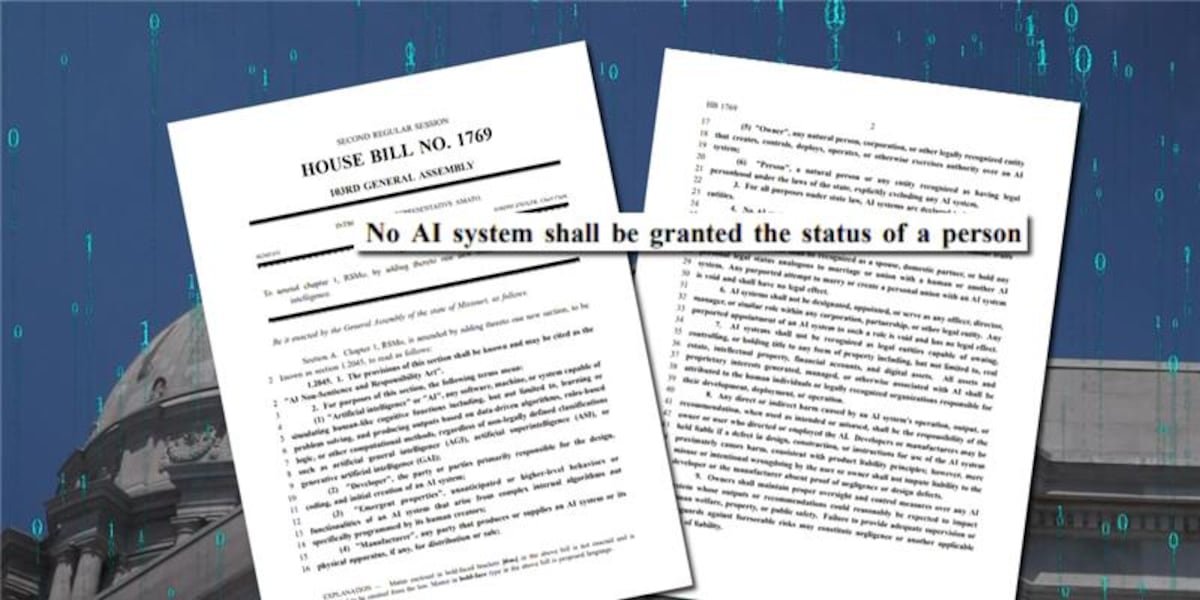
JEFFERSON CITY, Mo. (KCTV) – Would you ever marry artificial intelligence? Would you consider AI a person?
A bill gaining support at the Missouri Capitol would ban AI from having any of the privileges of being a human, including banning marriage for AI. St. Louis Rep. Phil Amato is crafting a bill that would define what AI is by defining what it is not. The bill was pre-filed on Monday and has already gained support from several key players in the Missouri legislature. The 2026 legislative session starts Jan. 7.
The bill reads “No AI system shall be granted the status of a person,” and it was crafted with the help of an AI researcher and developer with the intention of laying the foundation as AI continues to evolve.
“Our approach should be what AI cannot do,” Amato said. “It cannot get married, it cannot sit on the board of directors, it can’t be your boss. So, therefore, a human being at some place has to be the one that pushed the button to initiate whatever the creative thing or software, whatever you’re doing.”

Experts in multiple fields are in support of regulations for AI, but technology typically evolves faster than government regulations can keep up.
Children’s psychiatrist Dr. Arpit Aggarwal researches some of the ways AI has been used, specifically looking at chatbots marketing toward children as therapy. He said regulations are needed on these chatbots.
“There is a definite place for them, they’re not all bad, but if they market themselves as a therapist or psychologist by themself, then it’s not good,” Aggarwal said.
Amato’s bill would hold the people who developed the chatbots responsible for any potential harm.
“You can’t just abdicate responsibility and say, ‘Well, AI made me do it,’ some human being has to be responsible for pushing that button in the first place,” Amato said.
Copyright 2025 KCTV. All rights reserved.