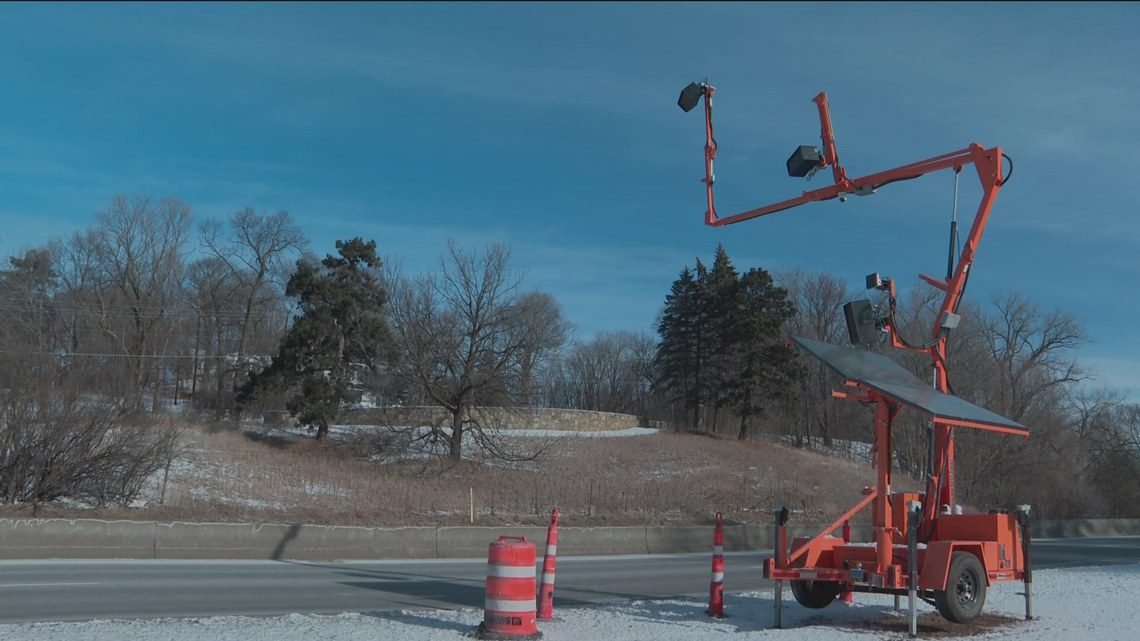
The tech is part of a $450,000 grant to improve safety on Highway 7.
EXCELSIOR, Minn. — If you commute around the Twin Cities, you probably know Highway 7 has a bit of a reputation.
At its best, it’s a fast-moving, convenient, east-west connection.
At its worst, many say it’s downright deadly.
Sergeant Adam Moore with the South Lake Minnetonka Police Department is well aware of that reputation.
“Five fatalities in 2024. Our citizens in this area have been outraged about it.”
Speeding and distracted driving are what really keeps officers busy.
“Probably the worst thing I saw was someone texting and eating a sandwich at the same time…right when I was next to their window,” Sgt. Moore says.
He says officers alone can’t keep an eye on all of it — which is why he says an extra pair of eyes in the sky may help.
Over the last few weeks, you may have the bright orange set of arms hovering over Highway 7 the last few days. It’s not a new construction project.
The Highway 7 Safety Coalition, comprised of departments along the roadway, received a grant to improve safety on 7.
Law enforcement is now partnering up with tech company Acusensus to deploy an AI camera that can detect when someone is driving distracted. The cameras can see right into your car, and see you on your phone. The tech can also detect if you’re not wearing a seatbelt.
We went out with Sgt. Moore to see firsthand how it works.
“So there’s a couple of different camera angles for each lane. We hear the alert pop up, it pops up on our screen and it shows us if there is a potential violation.”
He says officer discretion does come into play — the tickets aren’t automated or mailed out. The cost of the citation is similar to that of a speeding ticket.
“The AI kind of lets us know there might be a violation, but it is up to the officer to actually look at that photo and see that there’s a violation. Without that 100% ‘Yes, I see a phone in the hand,’ we’re not making traffic stops on that.”
You’ll see it move up and down Highway 7, popping up in different areas over the next year.
In the less than two weeks it’s been in place, officers have made at least 105 traffic stops and issued 56 citations.
Sgt Moore says officers can barely keep up.
“I was on a traffic stop and I heard four or five violations come through that no one was able to get because that many people were using their cell phones.
Sgt. Moore says he’s received a lot of interesting feedback from drivers so far.
“The four people I stopped today, I told them, ‘Hey, that orange camera that was back there. It took a picture of you on your phone and I saw it in your right hand.’ And I haven’t had anybody try to argue that point.”
Guilty consciences will hopefully lead to better decisions down the road.
As it becomes harder and harder to disconnect in an increasingly connected world.
“Really we’re looking to educate people,” Sgt. Moore. “Yes, we are writing citations for certain violations, but our goal is not to write the citations. Our goal is to get people to put their phones down.”
As for the privacy aspect, and what’s being done with those pictures…
If you’re pulled over and get a verbal warning, police say the picture stays in the system for 90 days. If you get a ticket or you’re arrested, it’s kept for longer for court purposes.
We reached out to the ACLU, which has been critical of traffic surveillance technology. They sent the following statement from Munira Mohamed, ACLU-MN policy associate:
Law enforcement use of AI-driven traffic cameras to spot distracted drivers raises major civil liberty concerns. This invasive technology could negatively impact the constitutional rights of anyone who drives on MN-7.
These cameras lead to indiscriminate mass surveillance, tracking faces and locations with little recourse for the vehicle driver. LE using AI cameras sparks a whole host of questions and problems:
How is the data being retained and who has access to it? How are police using the technology–Is a police officer coming to find you after the AI captures a photo? How does the AI tech prove that someone was distracted? Does the AI vendor have a cut of the profit raised from ticketing people?
The ACLU of MN sees the growing use of AI technologies without any legal or regulatory framework as a recipe for disaster. Civilians should have control over what technology our law enforcement is using and how they’re using it. Stopping a few bad drivers is not worth the erosion of our civil liberties and constitutional rights.