Frontline workers are having a moment as their importance in the age of AI grows across multiple sectors, including manufacturing and industrial enterprises, and organizations flatten. With all the talk of digital workers and AI agents taking jobs, frontline workers may wind up mattering more.
Two industrial conferences last week from QAD | Redzone and IFS highlight the trend, which Constellation Research has analyzed in two recent reports. Constellation Research CEO R “Ray” Wang noted that there’s a “once-in-a-generation opportunity to blend autonomous digital labor with human experiences” that will create “a new category of frontline worker productivity.”
“Success will require a level of contextual relevancy that is anticipatory. Based on experiences with more than 2,000 global clients, Constellation presents a future framework where services are delivered by hybrid teams of humans and agents. The revolution in frontline workers has begun, and organizations that adapt will thrive,” said Wang.
Sign up for Constellation Insights newsletter
Constellation Research analyst Mike Ni said that the new era revolves around decision velocity. “Winners won’t outmodel rivals or win based on the number of pilots launched but, rather, by the recurring decisions automated and the outcomes improved,” said Ni. “Enterprises stuck in pilots will fall behind irreversibly within five years. Decision velocity represents the compounding advantage of turning data investments into governed decision services that continuously learn.”
Simply put, data to decision velocity likely means that frontline workers become the new lead singers for enterprises. The band is enterprise data and AI (agentic or otherwise). Simply put, the humans in the AI loop are likely to be frontline workers.
Here’s a tour of how vendors are trying to address the new frontline worker AI age.
QAD | Redzone
QAD | Redzone’s focus is mid-market manufacturers consisting of a platform for enterprise resource planning (QAD), connected workforce software (Redzone) and Champion AI, which is a set of AI agents designed to be connective tissue across use cases.
At the company’s Champions of Manufacturing Americas conference in Dallas, CEO Sanjay Brahmawar said the plan is to “bring information and data right into the hands of frontline workers.”
With the help of automaton, process optimization and AI agents, frontline workers can make better calls and call the shots in the automation workflow.
Ken Fisher, President of Redzone, said QAD | Redzone’s goal with Redzone is to leverage AI and frontline workers as a tag team to create a feedback loop that drives productivity and faster decisions.
There’s also a cultural win too. “We provide culture change at scale where operators have ownership. They know what their targets are and what their losses are and they’re empowered to do something about it,” said Fisher.

IFS
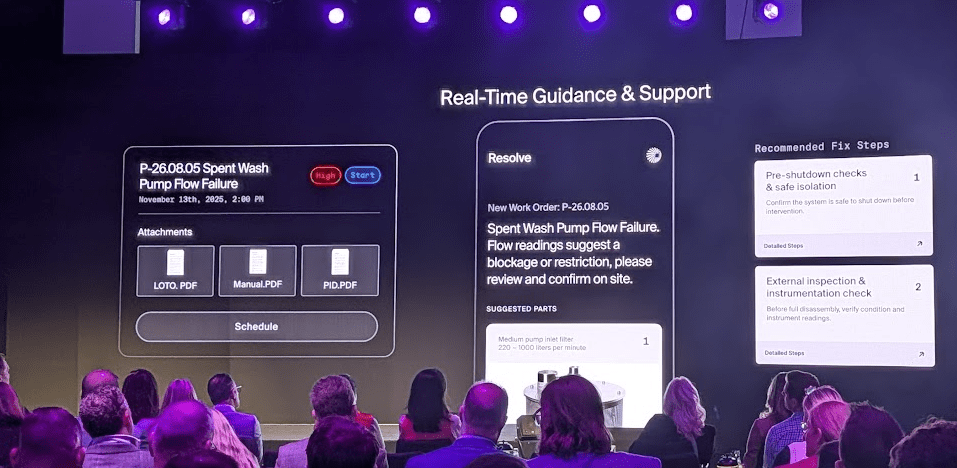
Speaking at IFS’ Industrial X Unleased conference in New York, IFS CEO Mark Moffat made the case for physical AI as a way to make industrial operations more autonomous.
IFS announced partnerships with Anthropic, Siemens, Boston Dynamics and 1X Technologies to embed AI, digital workers and robotics into industrial use cases. You’d think that this AI-meets-industrial strategy would mean fewer workers.
Instead, Moffat is betting few if any humans will be replaced. Moffat’s take is that AI can retool industrial infrastructure while maintaining jobs. Manufacturing already faces sever worker shortages.
According to Moffat, there are multiple trends pointing to the power of AI and industries including aging industrial infrastructure, labor shortages and retiring expertise and the need for automation and faster decision-making.
And who will make the tough calls in industrial AI? Likely frontline workers with an AI assist.
“AI Applied can embedded in real processes built for the real jobs and the work to be done. Industrial AI applied is about putting that AI capability straight into the hands of workforces, people in the front line. That’s where the rubber hits the road,” said Moffat. “Applied AI is different. It’s in context. It’s in day to day operations. It’s built for reality. The requirement for this AI capability needs to be offline, fully in context at all times, and mindful of safety. It’s built the people doing the actual work on the ground, running a line, inspecting a substation and keeping people safe.”
Jason McMullen, President and CIO for offshore drilling company Noble Corp., said the win for frontline workers and AI is documentation for institutional knowledge. McMullen said that there are only so many electricians and mechanics on a rig and some of them rotate. In other words, some frontline workers may be dealing with an issue they’ve never seen before.
“Some of these workers are in isolation. Having AI feed data to you to make a decision is critical,” said McMullen. “Having a human in the loop is critical for us, but it’s also about letting the humans know when they need to be in the loop.”
UKG
Perhaps it’s easier to connect the dots between AI, automation and human frontline workers in manufacturing and industrial settings, but there’s also a play for other verticals such as retail.
UKG at its Aspire conference earlier this month rolled out a series of AI agents and assistants to transform the frontline worker experience.
The company outlined the following:
- A vision for UKG’s Workforce Operating Platform that would use agentic AI to reshape the flow between people, technology and frontline work. The key words for UKG are orchestration, AI and data to enable enterprises to be more proactive.
- UKG also announced its Workforce Intelligence Hub, which provides end-to-end visibility into frontline operations. The insights in the Workforce Intelligence Hub can better activate AI agents, hone frontline hiring processes and align labor and customer demand via UKG’s Dynamic Labor Management.
- UKG plans to roll out its agentic AI applications throughout 2026.
According to UKG, AI can give frontline workers better experiences by giving them a conversational interface to access schedules, punches, benefits and HR information and payroll. UKG isn’t alone. Workday, Salesforce and ServiceNow, which is also a UKG partner, are among multiple SaaS companies are aiming to court frontline workers.
In a 2026 megatrends panel at UKG Aspire, frontline worker engagement was flagged as a critical issue. Frontline workers need engagement and career paths. UKG quoted Ty Breland, CHRO at Marriot, saying that AI isn’t going to replace the human touch — it’s going to bring it forward.”
Indeed, Constellation Research’s Supernova 2025 awards featured a few finalists including Spacetel, Doctor Care Anywhere and SavATree that delivered ROI by engaging frontline workers.