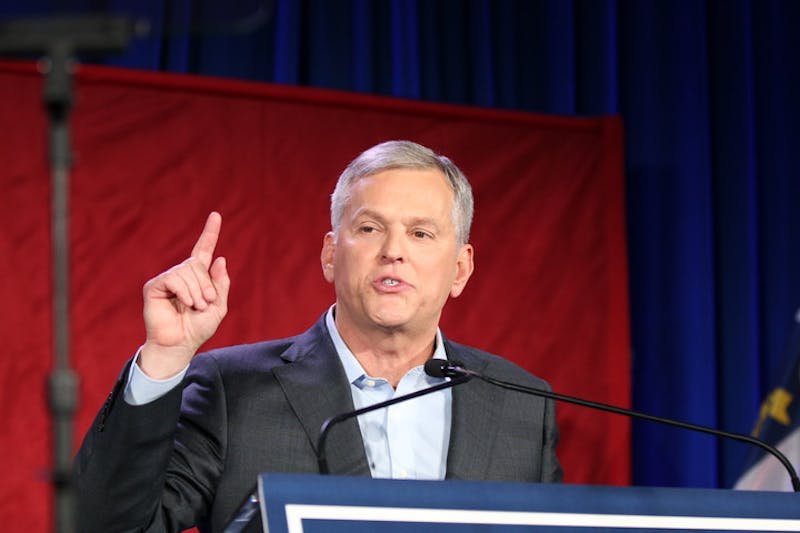
As artificial intelligence becomes more prominent in the lives of students, workers and everyday citizens, the North Carolina state government is tapping into the transformative technology. Gov. Josh Stein signed an executive order Sept. 2 that focused on how artificial intelligence can enhance the state government and technology sector of North Carolina. The executive order established an AI leadership council, an AI accelerator, oversight teams for each state agency and training programs for AI literacy and fraud prevention.
As per the press release from Gov. Stein, the emphasis on AI will prepare the state government for emerging industries and technology that are rapidly affecting the lives of North Carolinians.
The AI accelerator will be overseen by the North Carolina Department of Information Technology and will add to the implementation of AI across state agencies. The council will make recommendations to multiple state agencies including NCDIT and the North Carolina Department of Public Instruction to develop literacy training that will be accessible to the public.
The AI leadership council is made up of 25 active members who represent three areas of expertise: government, academia and private sector work. This council is appointed by the governor to two-year terms, where they may be reappointed at the end of those terms. The council will be co-chaired by the secretary of the North Carolina Department of Information Technology, Teena Piccione and Lee Lilley, the secretary of the North Carolina Department of Commerce. The council has yet to hold its first meeting.
Stan Ahalt, the dean of the University of North Carolina Chapel Hill School of Data Science and Society, was approached by the governor’s operations team to gauge his interest in joining the leadership council. While he has not been assigned a specific role within the council, he said he believes that because of the diversity of expertise and experience of people on the council, they will be able to approach any problems that the governor or state agencies may face with a wide range of knowledge.
“Given the variability of the type of people they’ve asked to be on the council, I think they have a distribution of people from the private sector, industry, state agencies, the General Assembly and academia,” Ahalt said. “So I think they tried to pull together people that could give advice across a broad swath of activities at the state level.”
The creation of this council comes a few months after Amazon announced a $10 billion data center in Richmond County and as other states such as Rhode Island and Virginia create AI task forces.
“An early indication is the number of companies that have shown interest in moving into the state for various technological and I’ll even say geological reasons, in the sense that we have a lot of natural resources in the state of North Carolina that are very useful for AI, for example, I think some very significant portion of the quartz that’s used to make chips is mined here in North Carolina,” Ahalt said.
Part of the council’s role is to advise state agencies on the implementation of AI and provide support. Tommy Sowers is the deputy director of Duke’s Initiative for Science and Society and another member of the AI leadership council. Sowers said the council will collaborate with civil servants to form ideas on how to utilize this new technology.
“It’s not just sort of outside counsel coming in and coming to the government and saying, ‘you should do this,’ but there are loads of really smart, dedicated public servants that are already exploring and thinking about these tools,” Sowers said. “It should be a very mutual beneficial relationship of ideas being generated from within government, and the council also bringing in ideas from outside of government.”
This past summer Sowers led a program at Duke that worked with the governor’s office on how to implement AI to alleviate the workload of government agencies.
While there is a concern that implementing AI can lead to government workers losing their jobs, Ahalt said that while he shares that same concern about emerging technology replacing workers, he ultimately agreed that the goals of the council will be to help alleviate the workload of civil servants.
“In contrast to the way it’s portrayed by some, I think our government workers are very hard-working, and in many cases, areas are understaffed,” Ahalt said. “If we can find ways of bringing a greater degree of joy to people who are doing the hard work for the citizens of North Carolina, that would be just a wonderful outcome, and I hope we’re doing that in ways that increases the efficiency and impact for citizens of North Carolina.”
The executive order outlines the duties and responsibilities the council will focus on such as providing recommendations to the Department of Commerce, creating an AI literacy strategy that can be implemented statewide and providing guidance on ways to protect infrastructure from AI risks. The council will meet in-person every quarter and provide the governor with an annual report on any progress or challenges they have faced during the year.
“I would be optimistic that people would look at the fact that this council is being set up in a way that’s very inclusive and have some confidence that the government is trying to wrap its collective head around all the things that AI might impact and take advantage of it for the state of North Carolina and the citizens,” Ahalt said.
Megan Walsh contributed to the reporting of this story.