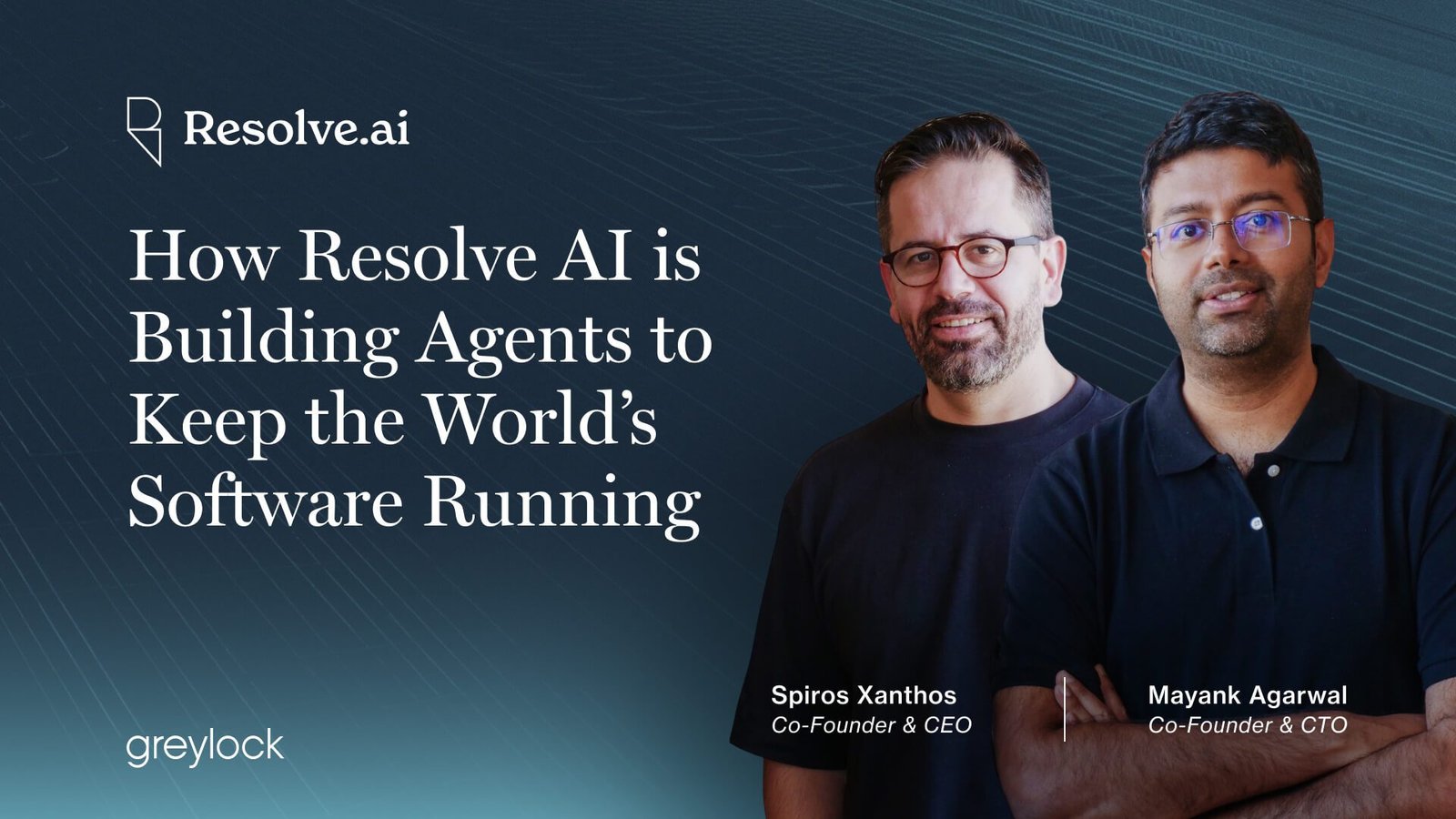
Four years ago, when Spiros Xanthos was at Splunk, he watched his best engineers succumb to the constant stress caused by system incidents and outages.
These were smart, motivated engineers who’d joined the company to solve interesting problems. Yet one by one, nearly his entire site reliability team left the company.
“It wasn’t the kind of creative work engineers want to be doing,” says Spiros, then Splunk’s General Manager of Observability. “They want to build great things, not be texted at 3 a.m.” When a crisis hit, his team would scramble through the night, tracing problems across tangled infrastructure, while Spiros found himself on calls with customers’ CTOs, apologizing and outlining potential fixes.
If there was a culprit, it was complexity itself. Splunk had made six acquisitions in just two and a half years, stitching together disparate systems and creating inevitable fault lines. “Everyone was working incredibly hard, but there were a million ways things could break,” says Spiros. “It was nearly impossible to predict where the next failure would happen.”
The challenge wasn’t unique to Splunk. The root of the problem, Spiros says, goes deeper than complexity. “We equate software engineering with coding, but writing code is just a fraction of an engineer’s job,” he says. “The majority is keeping that software running. It’s the hardest part of engineering yet seldom talked about.”
Long overdue innovation
Today, the problem has intensified. While AI is making it dramatically faster and easier to write code, the most difficult and tedious part of engineering work has seen little innovation. “We’re facing a new crisis where we’re building faster than we can operate,” says Spiros.
That realization prompted Spiros and his longtime friend and co-founder Mayank Agarwal to start Resolve AI in early 2024. The company is building AI agents that help engineering teams run production systems and resolve incidents. Resolve AI’s agents understand a company’s entire software stack, from app and code to infrastructure and all the tools around them. They can reason through problems like experienced engineers and learn with every interaction.
Customers are using Resolve AI to autonomously triage issues, make debugging conversational, and identify root causes faster than human teams working alone. The results have been striking: customers report cutting incident resolution time by 70%+, boosting on-call productivity by 75%, and saving as much as 20 hours per week per engineer. Resolve AI has already signed several large financial services and technology companies, while rapidly hiring top-tier AI talent to keep up with demand.
As a four-time entrepreneur, Spiros attributes the company’s fast start to valuable lessons he’s learned along the way. “I’ve made plenty of mistakes,” he says. “But each time, I managed to do things a little less wrong.”
Taking the hard road
Spiros’ entrepreneurial streak began with a rejection of a dream job. After growing up in Greece, he came to the U.S. for graduate studies at the University of Illinois, pursuing a PhD in computer science. In 2005, a summer internship at Google led to a coveted full-time offer at the company’s Mountain View headquarters: at the time, one of the hottest tickets in tech.
As Spiros was ready to sign on, his advisor made a counteroffer: she proposed that they start a company together with two other grad students. Spiros remembers it as a difficult decision. “Do you join this amazing company where you’ll tackle a huge variety of problems?” he says. “Or do you go out and start a company without any idea how to do that?”
In the end, he chose the riskier and more challenging path. “Whenever I have two choices, I think about which one is the harder thing for me to do, then I pick that one.”
After turning down Google and dropping out of the PhD program, Spiros co-founded Pattern Insight, which built software to help companies make sense of massive volumes of machine-generated log data. Cisco, Qualcomm, and other Fortune 500s became customers, and the company grew to millions in revenue before VMware acquired it in 2012.
The experience gave Spiros a taste for startups. After working at VMware for 2.5 years, he started Ezhome, a digital platform for home maintenance and improvement services, and later, Omnition, a next-generation observability startup. At Omnition he also helped create and grow OpenTelemetry, a hugely successful open source project that underpins modern Observability. Splunk bought Omnition in 2019, and Spiros spent four years inside the company – long enough to experience the headaches of running a large software system that eventually inspired Resolve AI.
Despite successful exits, Spiros never considered walking away from entrepreneurship. Startups, he says, are in his blood. “I’m happiest when I’m building, and solving hard problems with people I really enjoy working with. That’s the most fulfilling way to live my life.”
Lessons learned
Over nearly two decades of building, Spiros has accumulated a playbook of hard-won lessons. At Resolve AI, they have become guiding principles: obsessing over customers from day one, treating talent as the most important aspect of building a company, staying in sync with his co-founder, and practicing radical transparency.
Customers on day one
Many entrepreneurs hesitate to approach potential customers with a product that still feels unfinished. Spiros once felt the same. But prior experience taught him that bringing customers into the process early is the only way to build something truly great.
At Resolve AI, Spiros sought out “design partners” who could validate the idea, stress-test the technology, and shape the product with real-world needs. The key, he says, was finding partners willing to live through the inevitable flaws of an early-stage product. “They’re not just your early customers. They’re the people you trust to have patience and help you build.”
The real validation comes later. “When design partners try to explain the product and almost sell it back to you, that’s when you know you’ve hit something,” Spiros says.
The approach accelerated development cycles and gave Resolve AI confidence when approaching large enterprises. Within a year, all of the design partners converted into paying customers, and became some of the company’s strongest advocates. Recently, after several months of collaboration and controlled rollouts, several large enterprises signed on to use Resolve AI agents.
Talent destiny
Another early mistake: waiting too long to hire. Like many founders, Spiros initially tried to do too much himself, before coming to the realization that who you hire matters more than what you build. “The only way to create a great company is to convince people who are as smart or smarter than you to join,” he says. “Talent is the most critical driver of a company’s trajectory.”
One of the main challenges in building a startup today is attracting smart, seasoned engineers. Recruiting is the activity where he spends a lot of his time – a reflection of both the intense competition for AI talent and the company’s unique demands. Resolve AI isn’t just looking for AI experts or systems veterans. It needs the rare individuals who can bridge both worlds, combining deep machine learning expertise with hard-earned experience running production systems at scale.
Despite this, Resolve AI has managed to hire AI and GTM leaders from DeepMind, Meta, Google, Microsoft, Windsurf, and more, along with sales leaders from Databricks, Meta, Square, and Snowflake.
In a hyper-competitive talent market, especially for tech roles, Saam Motamedi, partner at Greylock Partners, believes Resolve AI’s mission gives it an edge. “The company is solving problems engineers have personally lived through. Taking a job at Resolve AI means people can have an outsized impact in making engineers ten times more productive.”
A trusted partnership
When startups fail, the blame often falls on the technology, the timing, or the market. But in Spiros’s view, the most common cause is far simpler – unresolved conflicts between co-founders. “It’s really because founders have different aspirations, approaches, or goals and they can’t resolve them or they’re not honest with each other or themselves,” he says.
Over the years, Spiros and Mayank, who first met at the University of Illinois, have developed a close, collaborative relationship. The pair have worked together for more than a decade – at VMware and Splunk, and as co-founders of Omnition and again at Resolve AI. “We balance each other, we trust each other, and we’re brutally honest,” said Spiros. “This allows us to resolve our differences very quickly and easily.”
Radical transparency
That same candor Spiros has with Mayank extends company-wide. In previous startups, Spiros sometimes shielded employees from bad news, only to find that it eroded trust. At Resolve AI, he practices full transparency, whether it’s how much runway the company has, what customers are saying, or where the product stands.
“Startups are built on trust,” he says. “So, you eliminate anything that takes it away and double down on anything that creates it. I’m a huge believer that a strong culture matters more than strategy.”
The road ahead: AI for software engineering
For all that Resolve AI has accomplished in less than two years, Spiros sees the company at the beginning of a much larger transformation. He believes AI agents will redefine what it means to be a software engineer. “Agents will perform all the engineering tasks like coding and debugging systems. Humans will operate at a higher level of abstraction overseeing the AI,” he says.
It’s a change he sees as inevitable, not optional, and one that can deliver on the exponential productivity gains the industry has long sought. “We will produce technology 100x faster,” he says.
It’s a bold vision that extends far beyond keeping production systems running. For Spiros, Resolve AI represents the first step toward a future where engineers can focus entirely on creative work, while AI handles the operational complexity that has consumed so much of their time.