Whether you are a small town or a large city, moving development projects through the public process to aid in solving the housing shortage is important.
And if an AI-powered technology can remove some city hall friction, that’s a message that often lands, said Nichole Sterling, mayor pro tem and Board of Trustees member in Nederland, Colo., and founder of the company My Town AI.
“What do you say yes to as an elected official? I would say yes to more quantified dollars coming into my community. Getting to breaking ground faster for development,” Sterling said last week during a panel centered around scaling a pilot project, at the second annual GovAI Coalition Summit* in San Jose, Calif. “What are those bigger outcomes that we want for our communities, and then start asking those AI vendors to deliver on it.”
To be clear, this was not a discussion about the particulars of AI tech. No one was debating the finer points of Claude versus Gemini. (However, the topic of data, and more specifically, “data hygiene,” has a way of creeping into any conversation that involves public-sector tech types.)
The conversation, led by Steve Towns, vice president of content strategy for e.Republic*, stuck to the more pragmatic aspects of the use of digital tools by government.
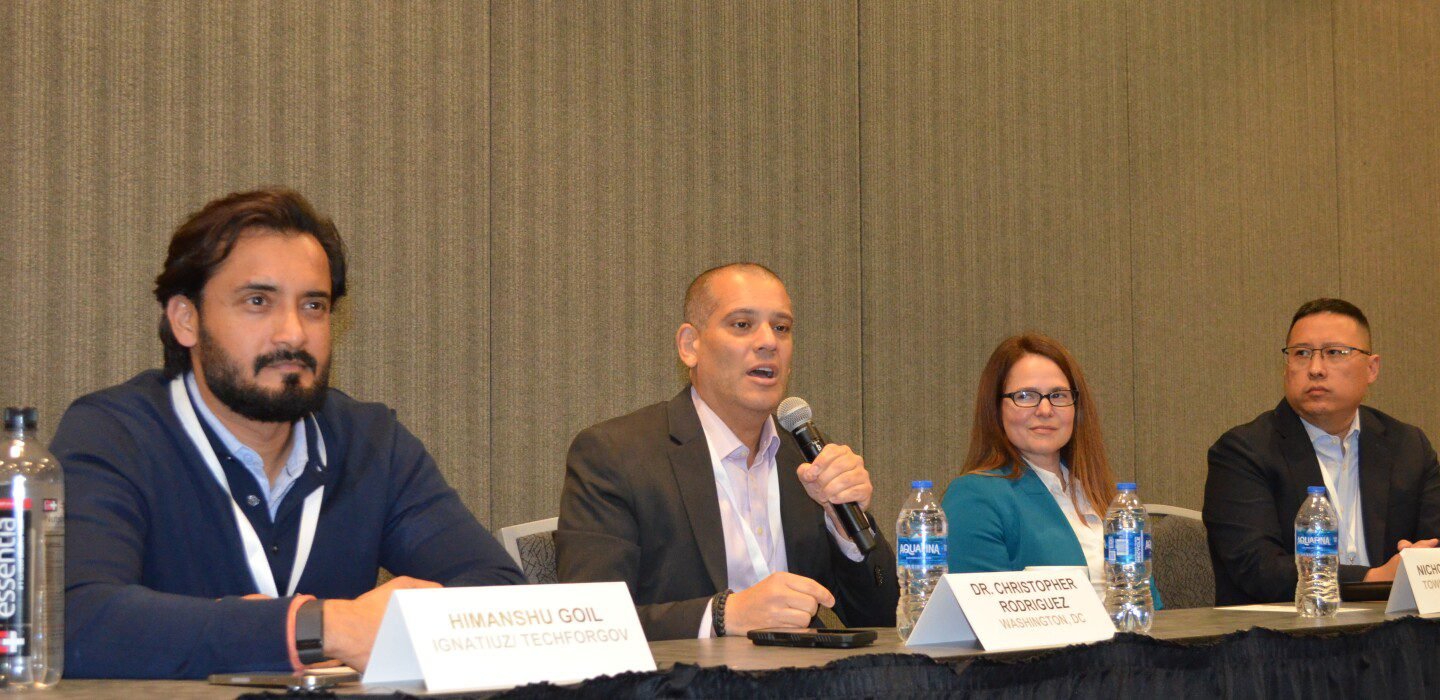
Know your audience, advised Christopher Rodriguez, assistant city administrator for Washington, D.C., with focuses on emergency management, cybersecurity and intelligence. Rodriguez is D.C.’s former acting chief technology officer.
“It’s efficiencies. It’s cost savings. And ideally, revenue generators, if that can happen,” Rodriguez said. “It’s also about public transparency. How does this help an elected official be more transparent? The other thing is, how are we making internal government process more efficient. How are we removing barriers to operation?”
There is the expectation among elected officials, Rodriguez said, “that AI is going to save us money.” And a pilot project ought to explore, “how is this solution going to maximize our services to residents, but also save us money over the long term.”
It’s not just big cities looking for efficiencies and improved services. Small towns are often “under-resourced,” Sterling said, underscoring their need for technology tools that can improve operations.
“Our citizens are no less demanding, and the services are no less needed,” said Sterling, who sits on the governing board of the town of around 1,500 residents. “I would just ask more of us to start asking, what are those bigger outcomes that we want for our communities, and start asking those AI vendors to deliver on it.”
Other areas ripe for an AI tech pilot project include “what is your biggest time-suck,” said Andrew Ngui, chief digital officer for city of Kansas City, Mo. “I would start with the most painful, the most annoying.”
The ability to measure a pilot and understand its results needs to be baked in, Ngui said. But he also recommended knowing the problem you are trying to solve.
“Are we truly understanding the challenges that our front-line staff face?” he said. “Do we truly understand their workflow?”
*The GovAI Coalition Summit is hosted by Government Technology in partnership with the GovAI Coalition and the city of San Jose. e.Republic is Government Technology’s parent company.