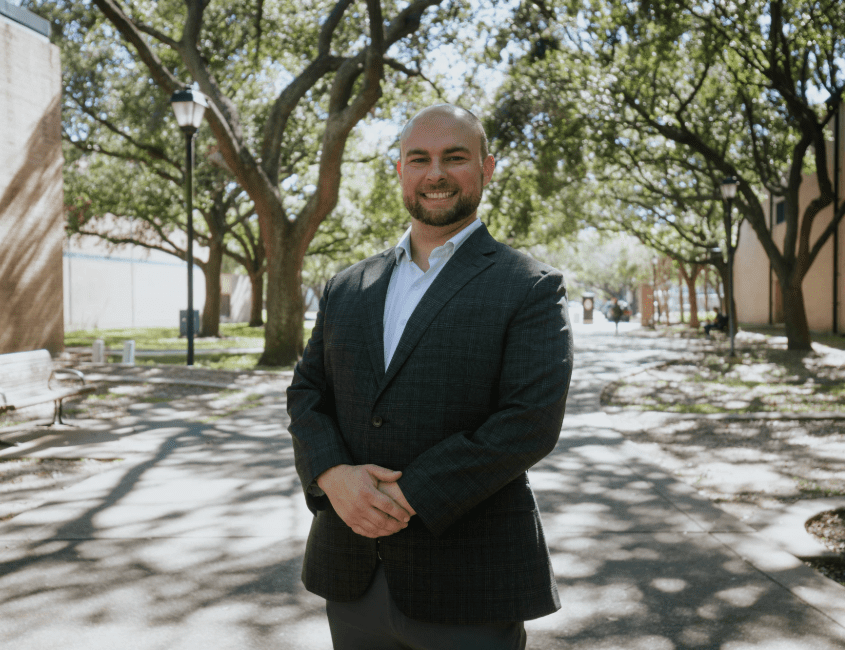
 In the conversation of artificial intelligence and the human person, University of St. Thomas doctoral philosophy student Michael Salvatore Politz is guiding insight for the nation. Politz is the recipient of the 2025 Spokeo AI scholarship, awarded nationally to one student every year. With strong competition from students around the nation from tier one research universities, Politz won for his essay titled, “The Limits of Reductive Materialism in AI Development,” which Spokeo shared in a press release in September 2025.
Politz’s essay and dissertation reflect on the uses and limits of AI from the perspective of Thomism and contemporary phenomenology. His background in STEM uniquely positions him to contribute to the current debate on AI and the human person.
Politz took time to engage in a Q&A with Senior Director of Communications Bridget Richardson on his background in STEM, the connections between AI and philosophy, and how he explores the human experience.
Bridget Richardson: What was your reaction to receiving news of the award?
Michael Politz: I was elated. It is an incredible honor to receive this award. On a personal note, it was validating to see that people were interested in a Thomistic perspective on the issue of AI.
BR: There is so much to unpack in your essay. You argue that current AI models overlook the experiential and relational dimensions of the human mind. You also write that human knowing is “transcendental.” How does that insight shape the ethical and spiritual implications of AI development?
MP: The field of AI development is incredibly vast, but insofar as AI (in any iteration) remains an artificial attempt of the human mind to mimic some of its own powers, certain limits will need to be observed. Most pressingly for the attempt to create something like AGI (Artificial Generalized Intelligence), a major limitation comes up in reference to artificially creating a “generalized intelligence” on par with the human mind. This is the issue of “transcendence.” Unpacking the totality of what is the “rational” difference of the human person spans multiple disciplines and still eludes a cohesive definition. It seems the human person (and the characteristic way of human interacting and navigating this world) is not reducible to neurology, psychology, biology, anthropology, sociology, or any of the other sciences that study parts of the human being. Rather, we seemingly need all of them and more. There is always more needed to explain the human mind, and in this way, it is transcendental.
Since we are having a hard time pinning down just what this more is that allows for the “rational” difference of the human person, it is difficult to see how we could accurately replicate ourselves when we have yet to even truly know ourselves. Within AI development, this problem is put under a spotlight, for although a cohesive definition of ourselves eludes most sciences (metaphysics excluded), we know certain key features necessary for human life and development. Chief among these features is our experiential and relational knowledge. Experience and being-in-the-world are hallmarks of the human, both of which are difficult, if not impossible, to replicate via artificial means.
BR: Your viewpoint makes sense as you described your path as “building a bridge between STEM and the humanities.” What inspired you to take that interdisciplinary route?
MP: As cliché as it is to say I just “fell into this route,” that seems to be exactly what happened. I have always been fascinated with the human mind and what makes us so unique within this world. To truly study all that makes us so unique requires a multi-disciplinary focus. I began in STEM, but continued to find more and more answers to the human puzzle popping up within the humanities. I started following the path of truth and have found myself here, for the more I searched, the more answers I found in Thomism.
BR: That’s a great way to sum up how science and how we operate in the world intersect. What drew you from biological engineering to philosophy? Was there a particular moment or mentor that changed your path?
MP: Fortunately, I have been blessed with many mentors in my academic career. My engineering and religious studies professors at Louisiana State University showed me that what it means to be human is not entirely encapsulated through modern scientific methods. My professors at the Dominican School of Philosophy and Theology showed me how the Thomistic tradition provides a necessary anchor from which the human person can be studied in all our idiosyncrasies. My professors here at the University of St. Thomas have shown me how to hone my Thomistic philosophy and apply it to current issues. All in all, I have been guided by a litany of incredibly intelligent and caring mentors. However, I would like to specifically mention my dissertation director, Dr. Mirela Oliva, here at UST. At every step during my time here at UST, she has shown me both what opening these lines of dialogue between Thomism and the modern scientific/academic fields can do, while simultaneously showing me how best to attempt these dialogues.
BR: Dr. Oliva is a standout professor at UST! How has studying philosophy at University of St. Thomas shaped the way you think about what it means to be human in the age of Artificial Intelligence?
MP: Uncovering what it means to be human spans multiple disciplines. However, studying philosophical anthropology at UST has given me the anchor necessary to conduct this study. Humanity has gone through many different paradigm shifts. AI is seemingly poised to be another major one. How we react and adopt AI into our everyday lives will play out in a myriad of different ways, but the study of what it means to be human will continue through this age, like it has through all others. What it means to be human will remain fundamentally the same. However, the addition of the cognitive tool that is AI may change the lives of many humans. Simultaneously holding true to our innate “humanness” while navigating the ramifications (good and ill) of our inventions seems to be the price of being intelligent enough to create Artificial Intelligence in the first place.
BR: How have you seen that a more holistic approach to knowledge can help us build technologies that better serve people rather than replace them?
MP: The current paradigm of technological development seems to be tilting more toward development for development’s sake. We want to see just how far we can bend nature to our will. A holistic approach to knowledge may help to reset the classical view of technological development — development for the sake of human betterment. Technological advancements have produced incredible tools to aid in human life. However, the burden of responsibility on how to utilize this technology is fundamentally a human issue. More and more often, we seem to be beholden to technology within our lives, as opposed to utilizing technology to live better lives. A better understanding of ourselves and of the current state of technological advancement may help to switch this paradigm and allow us to reclaim an innate human perspective while reaping the benefits of modern technology. I believe that, especially in reference to technological advancement, humans either believe themselves to be called to be stewards of this world or to dominate it. A more holistic approach to knowledge may serve to push us back toward our role as stewards.
BR: Acting as a steward is a great illustration. What role do you think Catholic thought – or the liberal arts more broadly – can play in conversations often dominated by technology and data?
MP: Liberal arts (and especially Catholic thought) re-orients us to the innate sense of wonder that spurs on modern science and “science” in general. At the heart of human inquiry is a sense of curiosity and wonder about both our lives and this world into which we are cast. Reinforcing a classical education to go along with the STEM fields helps reprioritize how beautiful human inquiry is through a classical education while showing its merits through the STEM fields.
BR: How does the UST community encourage you to explore these big questions about the person, consciousness and our relationship with technology?
MP: My time at UST has provided me with a scholarly community of incredible faculty members to guide me, while simultaneously providing a research environment that allows students to pursue individual interests. Studying AI while in a Thomistic philosophy program was not necessarily a straightforward route, but I received nothing but help and encouragement throughout my studies and research.
BR: That’s fantastic. What have you learned about the dignity of the human person through your research?
MP: Our dignity is usually addressed through theological means, but I have found that in introspection, there is much more to the human person than we have categorized or defined. Our dignity within Creation is seemingly an unavoidable conclusion, as there is something inherently different about humans as opposed to every other creature. In reference to the mental powers of the human person (the crux of my research in comparative cognition with AI), I learned that when studying the human person, there is always some aspect of more. We know ourselves quite intimately and fully, yet when trying to put down on paper just what we are, something always seems left out. There is something inherently more about us. Fulfilling the ancient command to “know thyself” brings us again and again to this mysterious more that is written into our very being. This mysterious sense of more then points to us occupying some novel and dignified position within Creation.
BR: That feels like something St. Thomas Aquinas or St. Augustine would say! How does your personal faith intersect with your academic work?
MP: Being a Catholic philosopher, I find myself in a very blessed position where my faith and academic work frequently intersect. As a pilgrim trying to walk in truth in this life, I find the search for this truth and spreading of it through my academic work to be a deep expression of my faith.
BR: When you think about your future – academically or professionally – how do you hope to continue uniting these disciplines in service to the common good?
MP: Hopefully, I will continue on and find a job as a professor. I would like to continue both researching and teaching, ideally within either a Catholic or classical learning institute. There, I hope to continue to pass on these foundational truths of a classical and Catholic education, meanwhile continuing to write, publish, and speak on the points of comparison between the STEM and humanities fields.
BR: Great. Finally, what gives you hope about the future of human intelligence?
MP: What gives me hope about the future of human intelligence is observing the past of human intelligence. Major technological advancement that dramatically change the everyday lives of many humans is not something new in our history. Yet, each time we have a major event, the study of the human person remains as mysterious and as worthwhile an endeavor as it always has. Think of something like the printing press. After its advent, the metaphysical makeup of the human person remained the same, but our lives did change. The mystery of our nature is something to be engaged in, and I believe we will continue to do so in this new technologically advanced age.