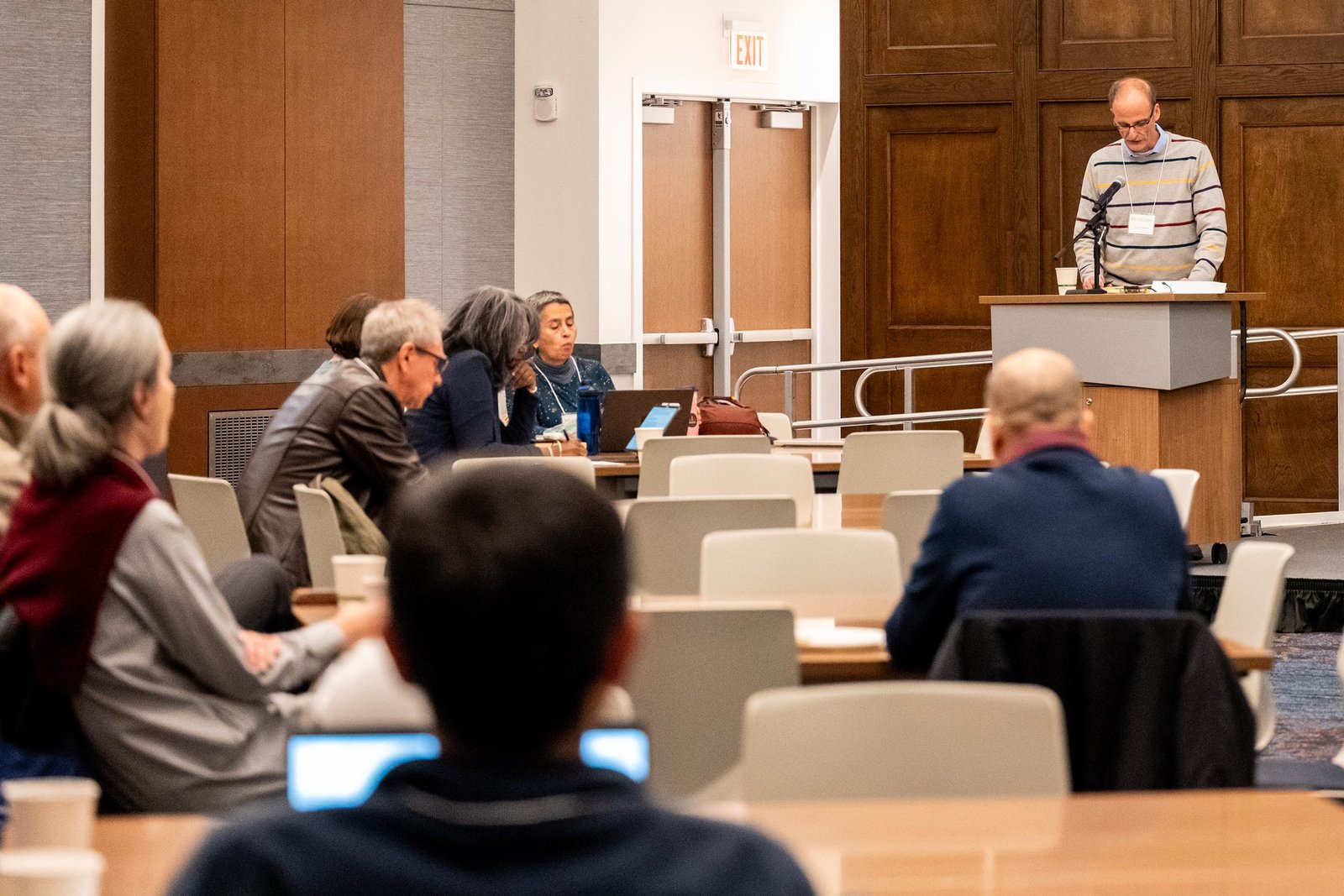
The University of Michigan Senate Assembly met Monday afternoon at the Alexander G. Ruthven Building to discuss upcoming Faculty Senate votes, artificial intelligence and University responses to the Big Ten Mutual Defense Compact and the Compact for Academic Excellence in Higher Education.
Derek Peterson, chair of the Senate Advisory Committee on University Affairs, spoke about several upcoming votes at the Faculty Senate meeting Nov. 3, including a vote on making Collegiate Travel Planners optional for faculty after the University’s new travel policy obliging faculty to book University travel. This change drew criticism from faculty who did not want to book through this program due to increased travel fees. At the same meeting on Nov. 3, the Faculty Senate will vote on a resolution to the Statement of Principles on the Presidential Search Committee.
“There is also an open letter, which has been authored by colleagues at the College of Engineering and other parts of the University, expressing unhappiness about the CTP situation,” Peterson said.
Then Ravi Pendse, U-M vice president for information technology and chief information officer, spoke about the role of AI at the University. He expressed his hands-off approach to the technology in the classroom, but emphasizes its importance if used responsibly.
“One thing I want to make very clear: at no point at this university, as long as I’m your VP and CIO, are (we) going to mandate that anybody should be using AI anywhere,” Pendse said. “That is not the idea at all. As a faculty member myself, I do not want anybody coming and telling me what I should be using and not using in my classroom.”
Pendse also emphasized the responsibility of the University to adapt to changing technology and demonstrate responsible usage. He said the University should adapt its education and pedagogical techniques to enhance these skills.
“Generative AI is going to be the most impactful technology of this century and a force for positive disruption,” Pendse said. “With all of your help, maybe we can show the world how to use this technology responsibly, ethically, legally and thoughtfully.”
Michael Schubnell, LSA research scientist, discussed the contrasting roles of AI in research compared to in education. He questioned how critical and creative thinking will change in response to increased AI usage in the classroom.
“In my research, I use AI, and I see the advantages,” Schubnell said. “I think there is a difference in research and in education. I think the issue is how do we encourage our students and teach our students critical thinking. How do we approach that, and how do we get help there?”
Pendse continued by discussing a potential faculty committee to advise on the use of AI in education. Pendse specified that he hopes it offers a multitude of perspectives discussing AI on the committee.
“The provost and I are intending to appoint a committee, a university-wide committee,” Pendse said. “The provost office will reach out to you and your leadership team to nominate appropriate colleagues to serve on that committee. Pick the most skeptical people. I would love to have them because we need those diverse voices at the table.”
Peterson then began the Senate Assembly chair update, where he discussed a SACUA visit last Friday to the U-M Flint campus to meet with faculty government and discuss a successfully negotiated contract from the University of Michigan-Flint American Federation of Teachers-American Association of University Professors that took effect in April 2025.
“We spent some considerable time looking over the contract in company of the AFT organizers and were impressed with the character of the bargain they were able to strike with the University,” Peterson said. “It’s instructive for us to think about what’s possible here in our own much larger version of the University and our own branch of the University.”
University Provost Laurie McCauley also attended the meeting. McCauley introduced the Institute for Civil Discourse, which will address issues of free speech on campus.
“We also recently announced the Institute for Civil Discourse, the name of it of which is not yet definitive or established yet,” McCauley said. “But an announcement of a new institute that will really just tackle this issue around freedom of speech and around inquiry and around differing opinions. This is an institute that is supported both by our strategic vision and also by philanthropy.”
When asked about AI’s potential effects on the cognitive and intellectual abilities of students and to address struggles with AI, McCauley discussed the possibility of a committee on AI with members of the Faculty Senate and resources being put forth for the University.
“We jointly sponsored a committee in 2023 when generative AI was just starting to envelop us,” McCauley said. “We both think it’s time to revisit that, to re-look at that original report, look at what we’re doing, and look at the future of what we should be doing, as a community.”
McCauley also added that new resources to support faculty in regards to AI are being implemented through The Center for Research on Learning and Teaching along with the Center for Academic Innovation.
“We’ve put in a lot of things in place to support our faculty,” McCauley said. “In particular, the Center for Academic Innovation has had opportunities for faculty to lead projects that they can explore new teaching methodologies around Gen-AI. (The Center for Research on Learning and Teaching) has many different opportunities for faculty to engage in learning how to grapple with the issues around AI.”
Peterson also asked about the University’s intentions to respond to the Compact for Academic Excellence in Higher Education. Trump proposed this compact to nine universities, offering preferential treatment if the institution complies with the administration’s conservative policies. McCauley answered by saying the University has not been formally asked to consider the compact yet.
“There’s not been a huge amount of support for the Compact across the nine institutions that were delivered the compact,” McCauley said. “We have not been formally asked to consider a compact. I have not heard any interest or any outreach for us to engage in any aspects of the compact. There are some aspects of the compact that we already comply with. I guess the short answer is I’ve not heard any appetite for it.”
Daily Staff Reporter Maddyn Shapiro can be reached at maddyns@umich.edu.