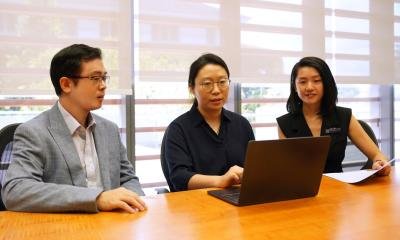
Serving as a digital co-tutor, AI enhances the learning experience through personalised feedback and realistic clinical simulations, helping to shape the next generation of healthcare professionals
Jasmine Ong
Dr Jasmine Ong from Duke-NUS AI + Medical Sciences Initiative and Principal Clinical Pharmacist at Singapore General Hospital, is a joint first author of the paper. She said: “AI is not here to replace clinical educators and mentors, but to empower them. AI enables educators and mentors to focus on what matters most – fostering meaningful connections with their learners. Serving as a digital co-tutor, AI enhances the learning experience through personalised feedback and realistic clinical simulations, helping to shape the next generation of healthcare professionals.”
Despite the potential of AI, its use in medical education currently faces challenges in terms of insufficient qualified trainers and a lack of tested implementation strategies. Another major concern about LLMs is their accuracy and credibility, with hallucinations or fabricated information remaining a persistent issue.
LLMs have presented biases related to gender and race, among others. Such biases, particularly when embedded within the medical literature, risk perpetuating systemic disparities over time. In addition, privacy concerns have also emerged, with the risk of patient information being exposed. Dr Ning Yilin, Senior Research Fellow at Duke-NUS’ Centre for Quantitative Medicine and joint first author of the paper, said: “As AI becomes more deeply integrated in medical education and training, we need to address the ethical concerns it raises, such as ensuring appropriate use, maintaining learning integrity and preventing unintended harms. These challenges call for clear guidance and inclusive, responsible design.”
Associate Professor Liu Nan from Duke-NUS’ Centre for Quantitative Medicine and director of the Duke-NUS AI + Medical Sciences Initiative, who’s also a senior author of the paper, added: “AI is transforming medical education worldwide. By working towards a comprehensive, global strategy and partnering across sectors, we can deploy generative AI responsibly to create more interactive, accessible training and translate gains into better care for patients.”
The researchers also pointed out that sustainable AI adoption in medical education and training calls for close collaboration across sectors. Healthcare institutions, medical schools, industry partners and government bodies need to work together to develop responsible, scalable and evidence-based solutions. The researchers hope such collaborations will bring about the development of practical frameworks to implement AI-integrated medical education and physician training. These partnerships are also key to establishing funding models and resource supports.
Source: Duke-NUS Medical School