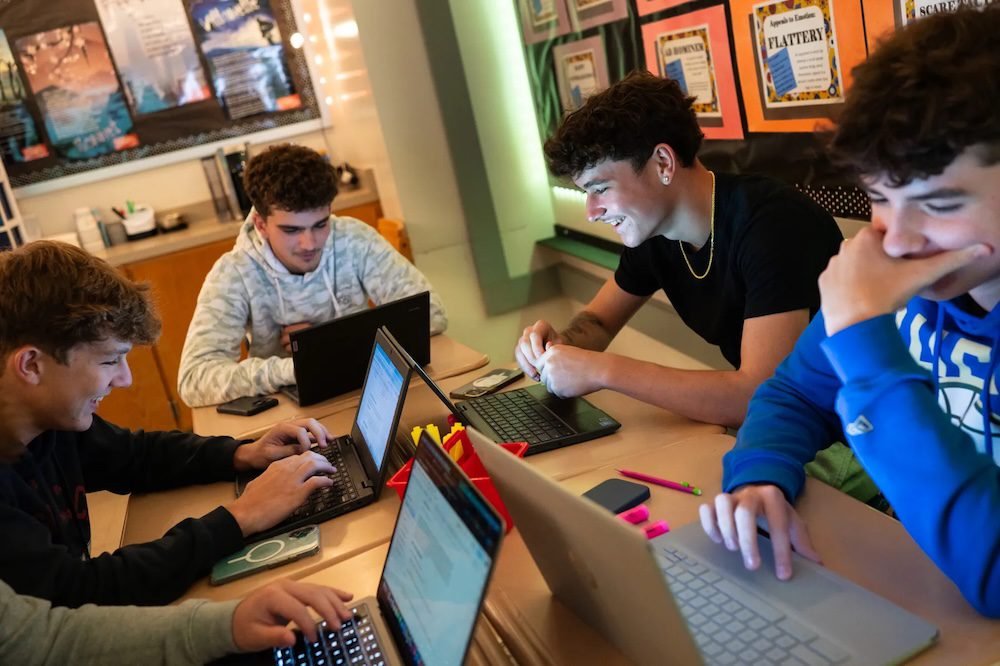
Teacher Denine Frye kicked off a recent 11th-grade honors literature class with an assignment tied to their assigned reading of the 1951 classic “The Catcher in the Rye” — but with a new character: AI.
She gave her 19 students at Hempfield Area Senior High School a prompt: “Write a short journal entry as Holden Caulfield as of chapter 14. Use his voice, slang and worldview.”
But instead of having them write the entries themselves, Frye asked students to enter the prompt into AI chatbots like ChatGPT or Google Gemini.
She then asked the students to evaluate the accuracy of the AI generation and then write their own analyses of protagonist Caulfield’s state of mind. How had AI helped them understand Caulfield’s character? She asked the students. Is it ethical to use AI as a brainstorming tool and can you rely on it for text analysis?
Frye said that in the AI era, she aims for “authentic assignments” that use new tools while ensuring the students are doing the work. She asks students to “reflect on what they did, and that way I’ll be able to assess their knowledge by them telling me what they did, because otherwise, I don’t know how I would be able to assess what they know right through the old methods.”

Frye is one of the many teachers in the region who has embraced classroom use of AI — a technology that is becoming increasingly common across the education sector.
A recent survey of teachers by Gallup and the Walton Family Foundation found that 60% used artificial intelligence tools in the last school year and a majority of respondents said it saved them almost six hours per week. The survey also found that the majority of the teachers agreed that AI carries significant risks, such as a decrease in students’ critical and independent thinking skills.
Teachers across Allegheny County are using a variety of AI-powered tools and programs. Many have found them helpful in reducing workload and generating ideas, but they have also expressed concerns ranging from academic dishonesty to privacy. Districts are recognizing the surge of AI and have started drafting policies and guidelines to regulate its use.
AI used in planning, grading and brainstorming
In her class, Frye encourages the use of Class Companion, an AI program that scores their answers and offers instant feedback. Students can rewrite their answers based on the feedback and improve their scores. In most of her classes, she asks students to use the program’s chatbot, Ditto, to assist them in brainstorming answers.
She uses tools such as CoGrader, which assists in essay grading, plus Brisk and Magic School AI, which help her create presentations, quizzes and ideas for projects.
At the Cornell School District spanning Coraopolis and Neville Island, Amanda Sappie has her middle school students use Class Companion to assist in science writing. She also uses Google Notebook LM, a tool that creates a podcast for students to introduce or review content.
Her colleague Jennifer Kosek, who teaches English, chooses not to use any AI in class or in student assignments. While she is open to exploring tools like Class Companion and uses AI for her own lesson planning, she said she doesn’t fully understand AI tools and feels unprepared to use them in class.

Kosek is participating in the district’s AI training pathway this year as part of her professional development at Cornell.
Eddie Willson, assistant to the superintendent for curriculum and instruction at Woodland Hills, said the district partnered with the University of Florida to use an AI tool targeted toward elementary students with IEPs learning computer science and robotics.
The Allegheny Intermediate Unit (AIU), which supports 42 school districts in the county, held an AI Fellows program last year. The program worked with teachers and administrators from 20 school districts to help them form policies and guidelines on responsible and ethical use of AI.
Rachel McVeagh, AIU’s instructional coach, said AI can be helpful in classes where students have different reading levels because some tools can personalize and adjust language according to a child’s needs.
“If you have students interacting with something that’s AI-driven, students can be learning the same topic, and [for] one student, AI is helping them receive the scaffolds they need, where[as] the student right next to them is getting deeper enrichment on the topic,” she said.
Teachers said using AI in classrooms has made their work more efficient by streamlining routine tasks such as lesson planning and gathering personalised feedback on student assignments.
Frye and Shaler English teacher Anne Loudon use AI to give students quick and basic feedback on grammar, repetition and whether their writing answers the assignment prompt.
Still, they emphasize that technology doesn’t replace the student-teacher relationship building that is essential to effective learning.

Adapting to an AI future
In this age of AI, where students can prompt a program to write any answer for them, many teachers have had to change the way they give assignments and assess students.
A recent MIT study said that using ChatGPT for essays involved lower cognitive engagement than relying on the brain alone. The users “consistently underperformed at neural, linguistic, and behavioral levels,” and using such Large Language Models — AI systems that can process large amounts of data to generate human language — could harm learning for younger people.
Teachers across districts have tried to mitigate this risk by changing their assessments.
Some teachers, like Loudon, use the stoplight method to control the use of AI for an assignment. A red-coded assignment means AI use is prohibited, a yellow-coded assignment allows AI for proofreading and brainstorming ideas and a green-coded assignment lets students use generative AI freely.
Other schools are taking steps to prepare students for a future shaped by AI. Baldwin-Whitehall has launched a pilot class this year focused on the fundamentals and history of AI.
“Never before has there been such an uncertainty as far as what that world is going to look like,” said Chris Reilsono, who teaches the class. “The one thing we can be certain about is that AI is going to be a part of that world, and the students that are able to utilize it effectively will have a leg up on their competition, no matter the field in which they choose to pursue.”
Cheating, privacy and hallucinations
For many teachers, AI is today what calculators or the internet were when they first entered classrooms a few decades ago.
Brian Stamford, an AIU program director who oversaw the AI Fellows, discourages teachers from using AI to generate entire lesson plans but said it can be used to brainstorm ideas and innovative ways to teach.
“The art of teaching is a very human-centered process,” he said. “And once you remove what you know about your kids and what’s in your heart and what’s in your head, once you remove all that and offload that to technology, it’s not very human-centered anymore.”
Loudon said when generative AI tools first came out in 2022, she had major concerns about cheating and plagiarism. But instead of stopping students from using it, she decided to equip them to use the new technology responsibly.
“Kids have always found a way to cheat,” she said. “I didn’t have the internet when I was a kid, [but] kids were still cheating.”

Some AI programs, such as Class Companion, can detect copied and pasted text in student assignments to reduce instances of cheating.
Reilsono said he is concerned about safeguarding students’ privacy. He teaches his students to understand what information the programs collect, and how it could be used and potentially impact them. He said he wants his students to be wary of AI hallucinations by fact-checking what it generates.
In Frye’s AP Seminar class, a group of students debated whether schools should use AI. Group members Sophia Stoner, Gabby Zurick and Makayla Swanton concluded that AI use should be restricted, saying that it outsources creativity, increases plagiarism and decreases student motivation.
Another student, though, argued that AI can help with prompts and ideas, and it should be up to the student to ensure that it’s not used to cheat.
Frye said the way she teaches has completely changed in the last couple of years. All of her classes now include an AI element, be it Google Gemini, Notebook LM or others approved by the district for classroom use.
Her next goal is to have Hempfield Area approve Suno, a music-generating AI platform. She wants her students to turn poetry into song lyrics, set a tone and mood and create a song or a music video out of it.
“I had to reinvent the wheel, and that’s why we do a lot of projects, and we do a lot of Socratic seminars, and we do a lot of reflections, where they have to actually show their knowledge in the reflection,” she said. “They can’t just go to ChatGPT and copy and paste.”