
After two years of funding contraction, 2025 is shaping up to be another challenging year for travel startups.
Meanwhile, artificial intelligence (AI) is moving from promise to practice. New entrants are often AI-native, building leaner products with smaller teams and faster cycles than their predecessors could imagine.
At the same time, incumbents aren’t sitting still: They’re retrofitting legacy platforms for the AI era. And investors are recalibrating. They know that technical moats no longer guarantee defensibility, and distribution and customer access are regaining primacy in their minds.
For founders, AI represents both opportunity and risk. It lowers barriers to entry, enabling young companies to reach revenue faster, but it also floods the market with competitors. For investors, it demands sharper discipline than ever, including separating sustainable growth from froth, rewarding business models that will solve real problems for years to come and looking ahead in an exit environment that is still constrained.
This year’s report, Phocuswright’s The AI-Native Edge: Travel Startups 2025, draws on Phocuswright’s proprietary database of more than 8,000 companies and a global survey of 150 founders. Together, these data points provide a candid picture of where the sector stands: undercapitalized and overhyped but full of optimism.
Just as past downturns set the stage for the next wave of category leaders, today’s uncertainty may prove to be fertile ground for the travel disruptors of tomorrow.
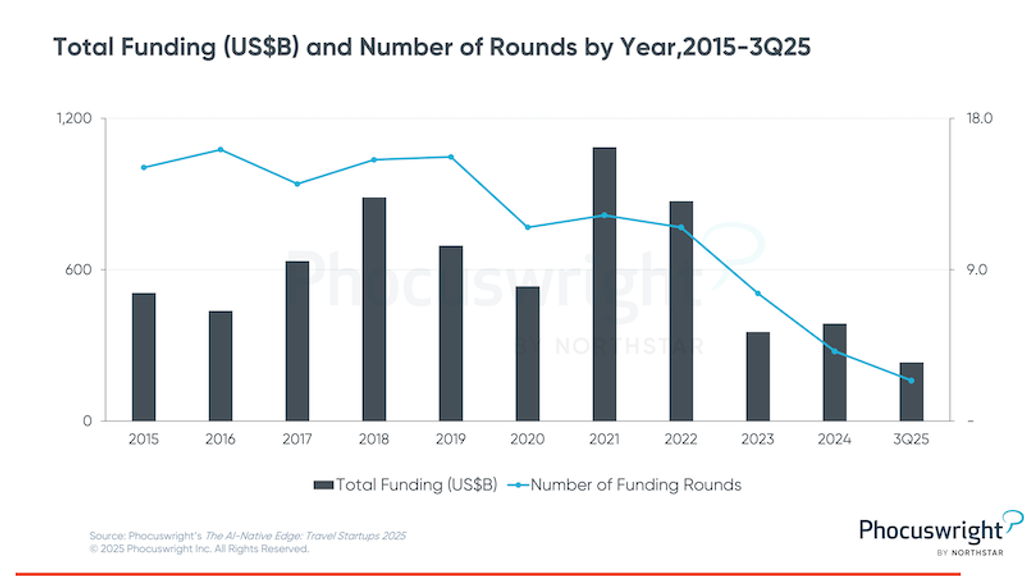
Investors are sitting tight
Investors are still in a wait-and-see period right now. The future is exciting but formidable with all the uncertainty that abounds. Stakeholders are trying to understand what’s coming with AI, in addition to navigating financial and economic variables. But uncertainty and dramatic changes have always created dramatic opportunities, and there are good reasons to believe that travel startup funding will rise dramatically once again, even if it’s more spread out.
In a September 2025 interview with PhocusWire, Chris Hemmeter, co-founder and managing partner at Thayer Investment Partners (previously mentioned as #1 in PhocusWire’s Top Investors in Travel Tech in 2025), confirmed an appropriate adjustment in their investing strategy.
“We have adopted a strategy that we call construct and convict. We find a number of early-stage experiments and make smaller investments in those companies to get a seat at the table. Typically what happens is a subset of those companies begin to take off. That’s when we come in with our conviction checks, which are much larger. We’re about to start investing out of our fifth fund and we expect to have between 40 and 50 portfolio companies in this fund,” Hemmeter said.
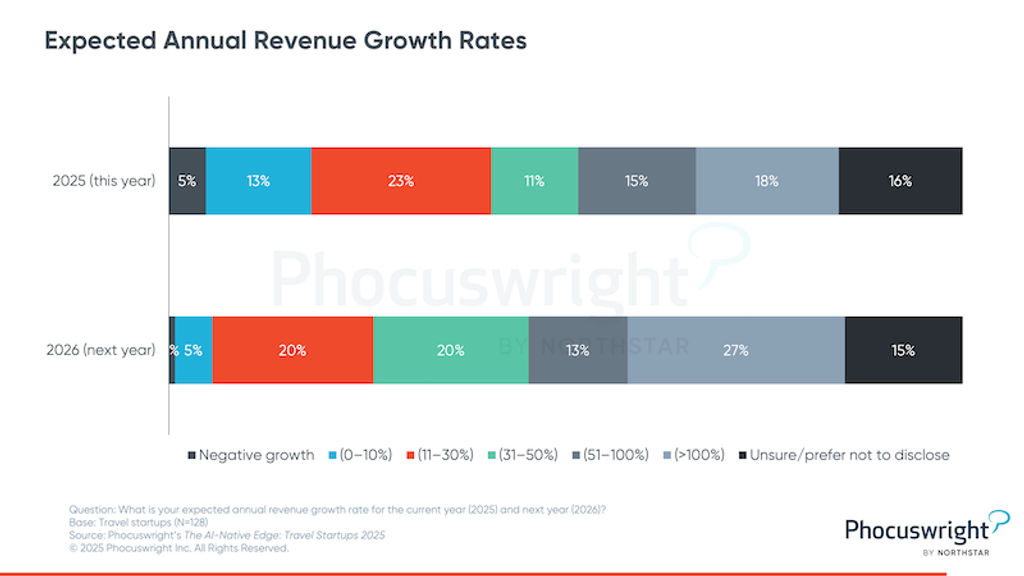
Most entrepreneurs are optimistic about their future, especially regarding growth. Only 5% expect growth under 10% in 2026, and nearly a third (27%) expect greater than 100% growth. Whether this will translate into venture capital (VC)-funded opportunities is a huge question.
What about the end goal for both startups and investors? The largest share of startups (37%) is hoping to be acquired by a travel industry company such as an online travel agency, hotel chain or airline. Sixteen percent hope to go public in an initial public offering. Twenty-four percent are aiming for an acquisition or exit of $10-$50 million, while one fifth are aiming for $100-$500 million and 17% are looking for an exit of more than $1 billion. For 42%, their preferred timeline for an outcome is three to five years.
These are realistic expectations, especially in the AI era. The general downturn in VC over the past few years, in conjunction with the rise of AI, has led to the popularization of “seed-strapping,” the idea of using AI to scale quickly to profitability or even an exit based on a single funding round. Some of the touted benefits include founders retaining larger shares of their companies, incurring fewer sunk costs and not having to stay on the VC treadmill.
If AI enables an explosion of seed-strapped companies, ideas should proliferate and many smaller businesses will be built. This may not be ideal for VCs, who need to sort through the noise to identify potential large outcomes. But it could be excellent news for acquirers looking to fold in strategic acquisitions, as well as for founders, who can still achieve life-changing outcomes even without billion-dollar valuations.
In short, AI may redefine not only how travel startups are built but how “success” is defined.
New this year…
Phocuswright’s annual startups report now features an AI-powered chatbot that can help answer your specific questions and pinpoint critical, topical research findings. Click “View” to try it in the full report.