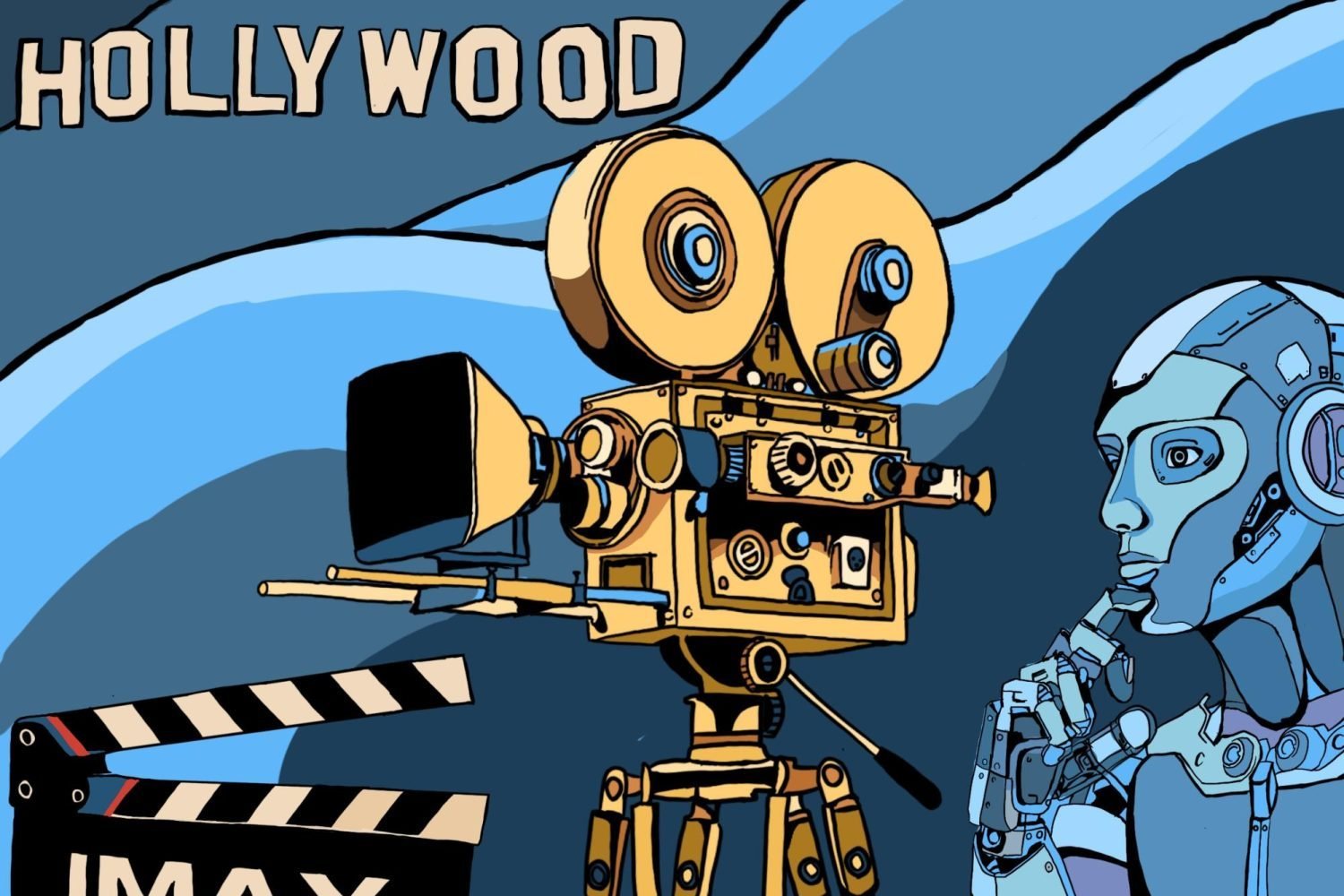

Today, the question of the role that artificial intelligence will play within the film industry has become more pervasive. This has brought up conversations on ethical and systematic issues.
The film industry has always been one of the first to adopt new technology, whether it be camera work, CGI, or motion capture. Artificial intelligence appears to be no different with its recent rise.
It’s no secret that AI has become an increasingly triggering buzzword, as it can elicit both positive and negative reactions in almost all fields. However, no field captures this reaction quite as strongly as the film industry.
For many, the film industry seems like the perfect target for AI, as big production companies are increasingly looking for more ways to cut costs and increase profit, and AI seems like the perfect way to do so.
However, for many aspiring filmmakers and individuals within the industry, this has become a growing fear and concern. Though AI brings efficiency and introduces new creative potential, it also risks eroding and limiting creative freedom and opportunities for individuals and the film industry as a whole.
Agencies often dislike AI being used, arguing that it leads to worse writing and an overall “if it ain’t broke, don’t fix it” mentality, but there are many things AI can do within the film industry.
It can plan cues, help with editing to ensure cuts are smooth, edit scripts, and plan out what shots need to be used during certain parts. This can increase efficiency and allow creative people in the industry to spend more time focusing on the artistic side of things. It could also allow more of the budget to go toward supporting these artists and ensuring the quality of the film.
However, the issue arises when that isn’t enough. If AI can handle the technical aspects, why can’t it do the less creative tasks as well?
Now students are turning to AI for more and more tasks. For instance, AI for screenwriting has become increasingly popular.
As AI writing tools become cheaper and more accessible, it’s understandable why filmmakers might decide to take this route to save money.
Along with that, students can use AI to improve visual quality, quicken post-production, and create cheaper visual effects. This allows for greater freedom in what can be done visually. AI has been used in films such as “The Irishman” and “Here” to de-age actors and refine digital performances. It has also been used in “Avengers: Endgame” and “Rogue One: A Star Wars Story” to digitally recreate or enhance the likenesses of actors.
Many people don’t realize how much AI is already embedded in what we watch. This seems scary to many, as people find comfort in the idea that you can always tell AI apart from real work, but that isn’t always the case.
Many big studios, such as Warner Bros., have turned to AI platforms which use AI to predict the success of films and scripts, such as Cinelytic. Along with that, AI was used to help create characters like Thanos in “Avengers: Infinity War.”
Here’s the first question that comes to mind after hearing this: what about all the people who did that work before?
That’s where the main issue arises. Writers, editors, and many other roles are being replaced with automation. This is where a line must be drawn between using AI to enhance creativity and using it in ways that actively inhibit or replace it.
To this, nobody knows the answer, and that’s where the fear comes from. Fear in screenwriting, especially after the Writers Guild of America (WGA) strike, is centered around the idea that studios will use AI drafts as templates for writing or even hand over real people’s ideas to machines.
Not only is this damaging for those currently in the industry, but many questions arise regarding the legality of copyright when it comes to AI usage. AI systems are trained on the work of thousands of artists and writers, essentially remixing existing creations into something new. While AI may seem cheaper in the short term by cutting down on human labor, the failure often comes when studios fail to consider the long-term impact, both on public perception and on the creative identity of film itself.
Another concerning aspect is that the likeness of actors is now being stored. Actors can sell their faces and voices, being paid simply for their digital likeness to appear in films they had nothing to do with. This has already occurred in productions like “The Flash,” where AI and CGI were used to recreate deceased actors and in Star Wars projects like “The Mandalorian,” in which a young Luke Skywalker was generated using AI-assisted de-aging. This poses serious concerns for those entering the film industry.
All this being said, there is no clear answer. The solution must come from the public, from audiences and consumers, as they decide whether they value data-driven storytelling and statistical optimization over human imagination. These databases don’t aim to make films nobody will watch — they aim to use AI to make films that statistically appeal to the most people, and that might be the problem.
As more films are being made and budgets continue to rise, it makes sense that studios want to maximize profit margins. But this raises another question: would audiences really want to see films designed purely for statistical enjoyment rather than creative expression?
Another major issue is the impact on workers and individuals in the film industry. Many jobs, from visual effects artists to camera operators, are at risk. Automation means fewer people are needed, and this ties directly into ongoing labor disputes like SAG-AFTRA and WGA negotiations over AI clauses.
With AI, many professionals see their jobs and livelihoods at risk. In a gig-based industry where nothing is guaranteed, this makes consistent work even harder to secure.
Studios and tech giants hold the power in this situation. They make the decisions, while many workers who have built their careers around these skills have few options. AI could deepen this divide, benefiting only a small group of tech-savvy elites while countless others lose opportunities.
This is where an important call for balance must be made. AI can’t be banned. Just like past innovations in the film industry, it’s here to stay. It can be extremely positive in increasing film quality and opening opportunities for lower-budget filmmakers. But there must be boundaries around this powerful tool to ensure it isn’t misused, such as consent for digital likenesses and transparency around AI use.
Many people feel that once AI becomes indistinguishable from human work, it no longer feels like genuine art, and that is a fear the industry must take seriously.