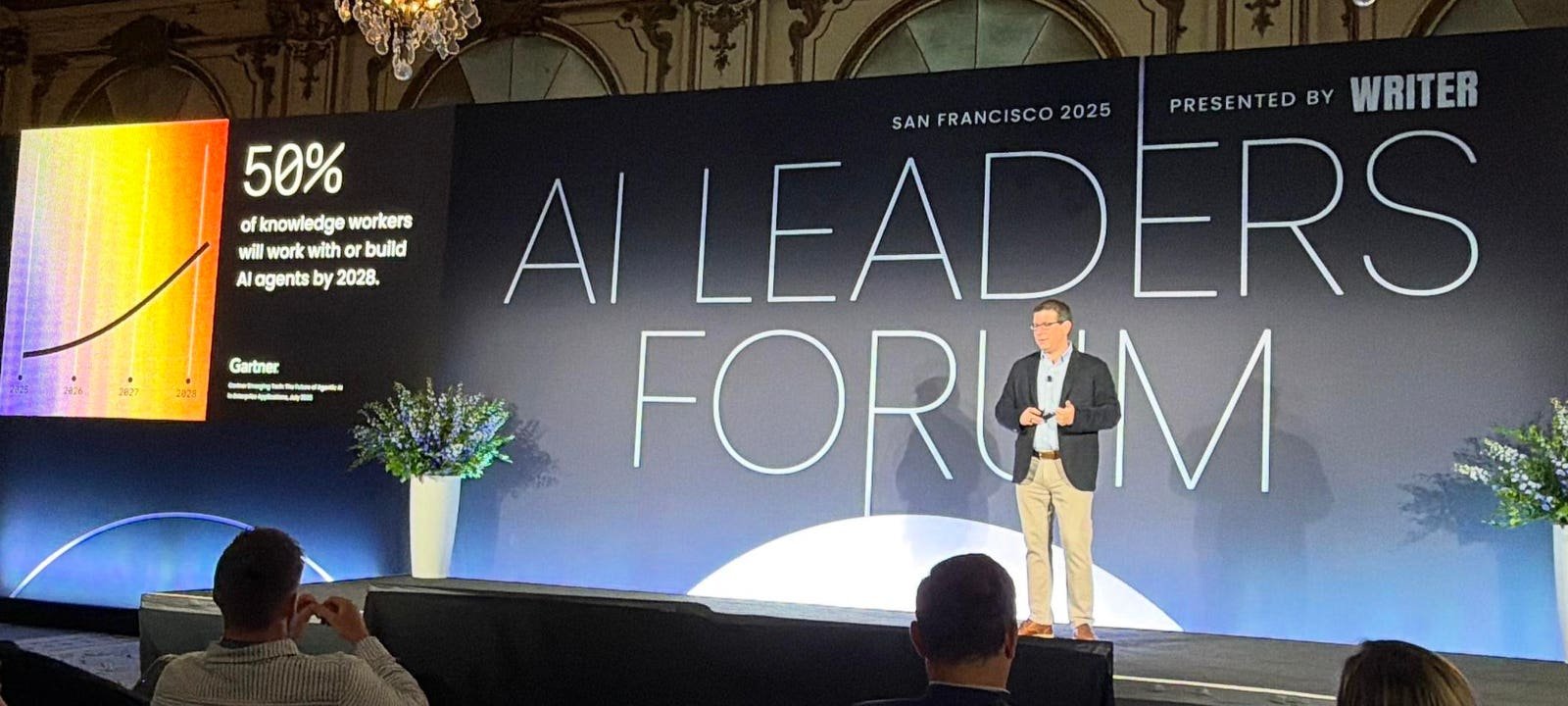
During the pandemic, Qualcomm marketing manager Brent Summers got curious about AI. That curiosity turned into something bigger: a company-wide transformation that now saves 2,400 hours monthly and creates what CMO Don McGuire calls “happier employees who are more productive, more creative, and more satisfied with their jobs.”
On November 4th at San Francisco’s Fairmont Hotel, Summers shared his journey at Writer’s AI Leaders Forum alongside executives from e.l.f. Beauty, Marriott International, Blue Federal Credit Union, and several others. What these leaders revealed wasn’t AI vaporware – it was the operational reality of companies capturing compounding advantages while the majority of enterprises today remain stuck in pilot purgatory.

Brett Summers, a Senior Marketing Manager at Qualcomm, was an early champion for Generative AI at the company, leading the evaluation and scaled implementation of WRITER.
Steven Wolfe Pereira
The contrast couldn’t be starker. New research led by Boston Consulting Group’s Janet Balis and Lauren Wiener with the Marketing and Media Alliance (MMA)’s Vas Bakopoulos reveals that only 15% of AI initiatives operate cross-functionally at scale to deliver enterprise value. Most remain trapped in individual functions or stuck in pilot mode. The remaining 85% are failing not because of insufficient technology, but because they’re making what Writer CEO May Habib calls a “category error” – treating AI transformation like previous IT rollouts and delegating it to departments that can’t redesign business processes.
A BCG study found c-suite leaders reported only 15% of AI initiatives at their companies operate cross-functionally at scale to deliver value at the enterprise level.
BCG
The 42% Problem And The C-Suite Disconnect
Habib shared a statistic that should terrify every executive: “Earlier this year, we did a survey of 800 Fortune 500 C-suite executives. 42% of them said AI is tearing their company apart.”
The diagnosis challenges conventional wisdom about AI implementation. “When generative AI started showing up, we turned to the old playbook,” Habib explained. “We turned to IT and said, ‘Go figure this out.'” That approach fails because AI fundamentally inverts how enterprises operate.
“For 100 years, enterprises have been built around the idea that execution is expensive and hard,” Habib said. “The enterprise built complex org charts, complex processes, all to manage people doing stuff.” AI flips that model. “Execution is going from scarce and expensive to programmatic, on-demand and abundant.”
Writer CEO May Habib shares her vision of the agentic enterprise at the Writer AI Leaders Forum.
Steven Wolfe Pereira
When execution becomes abundant, the bottleneck shifts from coordination to design – requiring business leaders, not IT departments, to drive transformation. “With AI technology, it can no longer be centralized. It’s in every workflow, every business,” Habib said. “It is now the most important part of a business leader’s job. It cannot be delegated.”
Inversion One: Empower Frontlines, Not Executive Suites
The companies succeeding at AI made three inversions of conventional wisdom.
The first: pushing control to frontline workers instead of centralizing it in executive suites or IT departments.
At e.l.f. Beauty – ranked #3 on Fortune’s fastest growing companies list with 27 consecutive quarters of net sales growth – Chief Digital Officer Ekta Chopra manages 85 different agentic AI pilots with an approach that captures this shift: “We want to give the tools in the hands of the people. This is not an IT project.”
Chopra established a cross-functional AI steering committee including legal, marketing, and R&D leaders. The company deploys “power users” – the employees most eager to use AI – as testers during pilot phases, with goals moving most agents into production within six months. Her philosophy combines bottom-up AI literacy building with top-down resources and strategy, orchestrating from the C-suite without becoming a bottleneck.
e.l.f. Beauty’s Chief Digital Officer Ekta Chopra shares her AI playbook best practices with WRITER’s VP Industry Principal for Retail Ranjan Roy.
Steven Wolfe Pereira
BCG’s research validates this approach: 70% of AI implementation challenges stem from people and process issues, 20% from technology problems, and only 10% involve AI algorithms – despite algorithms consuming disproportionate organizational time. Additionally, agentic AI is expected to handle more than one-fifth of marketing’s total workload within two to three years, making frontline empowerment increasingly critical.
At Qualcomm, Summers’ journey from pandemic curiosity to driving AI adoption across marketing exemplifies frontline empowerment. His playbook: start with personal productivity tools to build user confidence before expanding to strategic initiatives.
The results speak clearly. After Summers conducted his initial Writer pilot, 100% of the users wanted to adopt the platform full-time. Today, 85% engage with Writer weekly, with 60% using it multiple times per week. The company scaled from 50 people to more than 100 custom AI agents driving measurable ROI.
But the 2,400 hours saved monthly isn’t about doing the same work faster – it’s about frontline employees with deep domain expertise deploying AI directly on high-value problems that previously required layers of approval and technical intervention.
Inversion Two: Governance As Velocity, Not Control
The CEOs who say AI is tearing their companies apart share a common problem: their executives are literally speaking different languages about the same technology.
BCG’s research exposes the dysfunction in stark numbers. CMOs prioritize personalized interactions (ranked #1 by 57% of marketing leaders) and marketing effectiveness (45%). CEOs focus on enterprise value, growth, and new business models. CTO/CIOs measure success through cost efficiency, speed, and productivity gains. CFOs obsess over risk and compliance frameworks. They’re all right – and that’s precisely the problem. When every executive has a different definition of success, governance becomes a battleground instead of an enabler.
The lack of C-suite alignment on AI helps explain why companies have been slow to scale AI across functions. Beyond a shared belief that AI can drive cost efficiency, speed, and productivity, executives generally disagree about the future value that AI can create across the enterprise.
BCG
The research also reveals that only innovation in products and services creates common ground across CMOs, CEOs, and technical leaders. This explains why most AI initiatives get stuck: without shared language around outcomes, organizations default to siloed projects that satisfy individual executives but fail to deliver enterprise value.
Most organizations respond to this chaos by doing what feels safe: they hand governance to legal or the CIO, turn it into risk mitigation, and watch their AI initiatives suffocate under process. When governance lives exclusively in IT, it creates bottlenecks because the CIO’s definition of “done safely” conflicts with the CMO’s definition of “moved fast enough to matter.”
The successful 15% don’t resolve the C-suite disagreement – they transcend it. They recognize that governance isn’t about preventing bad things from happening. It’s about making good things happen faster.
“AI governance should not be a siloed function within the CIO’s office,” Habib told the Forum audience. “It must be an integral component of the overall AI strategy from its inception, serving as a foundational element for sustainable and responsible innovation.” Not because it sounds nice, she argued – because it’s the only way to move at the speed business requires.
E.l.f. Beauty exemplifies this approach. Chopra didn’t just implement technical guardrails – she established a cross-functional steering committee where legal, marketing, and R&D leaders hammered out shared definitions of both “safe” and “successful.” The infrastructure she built doesn’t just prevent problems – it accelerates deployment. Training proprietary data on large language models, building AI agents through Writer’s platform, moving 85 pilots toward production in six months – this velocity is possible because governance was designed to enable it from day one.
E.l.f.’s custom social media AI model, nicknamed “elf-luencer,” now generates content with 90% accuracy after nine months of training, using brand-specific language like “elf-mazing” and “elf-ing awesome.” While humans still review every post, community managers save significant time. The AI scales what humans created – it doesn’t replace human creativity. This works because Chopra’s governance framework explicitly addressed the CMO’s priorities (brand voice, customer connection) and the CTO’s requirements (data security, model reliability) simultaneously – not sequentially, not through negotiation, but through integrated design.
Here’s the distinction that matters: Companies treating governance as afterthought get stuck in pilots. Companies letting each executive pursue siloed AI priorities create expensive chaos. But companies aligning the C-suite on governance-as-velocity – on the understanding that proper guardrails enable speed rather than prevent it – move into production while competitors are still debating what “safe” means.
Inversion Three: Activate Ecosystems, Don’t Build Everything
The third inversion involves how companies approach their technological ecosystems. While most focus exclusively on internal capabilities, the successful 15% deliberately assess which systems, data access points, and strategic partnerships enable versus constrain innovation.
Writer’s SVP Partnerships Maureen Little discusses the importance of building a partner ecosystem with Snowflake’s AI Partners Director Timur Yarnall and Perficient CEO Yusuf Tayob.
Steven Wolfe Pereira
At Marriott International, this principle guides transformation at industrial scale. Paul Dyrwal leads AI initiatives for 750,000 employees across 9,000 hotels in 141 countries – navigating decades of layered systems and processes hardened into what he calls “bureaucratic concrete.”
Marriott’s response: use AI to fight organizational entropy rather than add to it. The company submitted over 200 AI use cases from employees globally, prioritizing efforts freeing 200,000 workers to focus on exceptional guest experiences rather than mundane tasks. Marriott’s tech investment for 2024 reached over $1 billion, the highest in company history.
But Dyrwal’s breakthrough insight reframes how leaders should think about AI returns: “Was everybody driving giant value out of the consumerization of the internet from day one. No, they were not. As soon as we figured out how to control electricity, were we immediately driving ROI out of electricity. No.” Every transformative technology takes time to deliver value. The impatience executives express about AI ROI reveals they’ve forgotten how technological revolutions actually unfold.
Paul Dyrwal, Marriott’s VP of Generative AI, discussed “Building A Builder Culture” with WRITER CMO Diego Lomanto.
Steven Wolfe Pereira
Marriott established an AI Incubator managing projects at various implementation stages. RenAI, an AI-powered virtual concierge, delivers relevant local recommendations via chat interface. A natural language search tool helps users find vacation rentals based on detailed criteria. These aren’t moonshot experiments – they’re production systems serving real guests generating real revenue.
Eric “ET” Trowbridge’s presence at the Forum also underscored an important reality: AI transformation isn’t just for tech companies and Fortune 500 brands. As Director of Development & Enterprise Applications at Blue Federal Credit Union, Trowbridge demonstrated how financial institutions of any size can deploy AI agents to enhance member service while maintaining the stringent security and compliance standards the sector requires. His participation proved that the three inversions – frontline empowerment, strategic governance, and ecosystem activation – apply equally to regulated industries where moving fast traditionally meant breaking things.
Eric “ET” Trowbridge, Director of Development & Enterprise Applications at Blue Federal Credit Union, shares his approach to bringing AI to financial institutions.
Steven Wolfe Pereira
Why This Feels Like Chaos (It’s Supposed To)
Writer CMO Diego Lomanto sees the Forum’s customer stories as proof of a fundamental shift in how AI transformation actually happens. “What I like to do is focus on the human side of it,” Lomanto says. “What kind of value are we getting? What are the successes? We want to show a real deep customer story instead of just the technology. That’s what people are craving.”
As a student of technology history, Lomanto cuts through current AI anxiety with perspective drawn from economist Carlota Perez’s research on technological revolutions. Every major technology – from steam power to electricity to the internet – follows a predictable pattern: an installation period marked by financial speculation and organizational chaos, followed by a deployment period where society reshapes itself around the new capability. “Society will reshape itself. Society will persist, society will survive,” Lomanto explains. “It’s just going to be in a different form than what we got used to.”
Writer CMO Diego Lomanto uses Carlota Perez’s framework on technological revolutions to guide customers through AI’s turbulent installation phase. History shows winners emerge during chaos, not after it settles – which is why Writer takes a hands-on partnership approach rather than just selling software.
Steven Wolfe Pereira
AI is squarely in the chaotic installation phase – explaining both the 42% of CEOs who say it’s tearing companies apart and the 15% who’ve figured out how to scale it cross-functionally. History suggests the winners won’t be those who waited for certainty, but those who embraced discomfort and learned through doing.
That historical lens shapes Writer’s hands-on partnership model. Writer executives regularly participate in customer adoption meetings, coach leaders on AI evangelism, and drive early momentum. This approach addresses the cultural inversions required for AI success.
The Three Leadership Shifts Redefining Success
Habib framed the transformation in terms of identity: “A generational transfer of power is happening right now. It’s not about your age or how long you’ve been at a company. The generational transfer of power is about the nature of leadership itself.”
Traditional leadership has been defined by managing complexity – big teams, big budgets, intricate processes. AI makes that model obsolete. The new leadership mandate involves three fundamental shifts:
Architects of Radical Simplicity. Leaders must take a machete to the complexity calcifying organizations. “We have customers where it used to take them seven months to get a creative campaign – not even a product, a campaign,” Habib said. “Now they can go from TikTok trend to digital shelf in 30 days. That is radical simplicity.”
Champions of Human Potential. When AI handles execution, humans focus on judgment, strategy, and creativity. But this liberation carries profound challenges. Habib acknowledged the fear executives avoid discussing: “These changes are still frightening for people, even when it’s become unholy to talk about it. It shows up as tears in an AI workshops when someone feels like their old skill set isn’t translated to the new.”
The solution isn’t looking away. “We have to design new pathways to impact, to show your people their value is not in executing a task,” Habib said. She advocates replacing career “ladders” with “lattices” where people grow laterally and expand sideways.
Hunters of Greenfield Opportunity. The final shift moves from optimization to creation. “Before AI, we used to call it transformation when we took 12 steps and made them nine,” Habib said. “That’s optimizing the world as it is. We can now create a new world. That is the greenfield mindset.”
The Bottom Line For Enterprise Leaders
What happens when Fortune 500 companies finally get AI right isn’t subtle or theoretical. It’s 2,400 hours saved monthly at Qualcomm. It’s 27 consecutive quarters of growth at e.l.f. Beauty. It’s 200,000 Marriott employees freed to focus on hospitality rather than bureaucracy. It’s employees reporting they’re happier, more productive, and more satisfied with their jobs.
For the 85% of organizations whose AI initiatives remain trapped in pilots or isolated functions, the path forward exists. But it requires doing something most organizations find difficult: inverting assumptions about how AI transformation actually happens.
BCG’s research with marketing leaders points to four critical actions: aligning the C-suite on AI’s role in enterprise growth, focusing on meaningful wins in end-to-end workflows, rethinking agency and partner relationships with new commercial models, and reimagining talent as AI takes on linear tasks while humans shift to higher-value strategy and creativity.
The question isn’t whether AI will transform enterprises. That decision made itself. The question is whether current leaders can make the mental shifts required – or whether they’ll be replaced by people who can.
At the AI Leaders Forum, Habib called attendees “the leaders we’ve been waiting for.” As she put it: “The future belongs to those who can see it.”
Can you?
The Writer team closing out the AI Leaders Forum.
Steven Wolfe Pereira