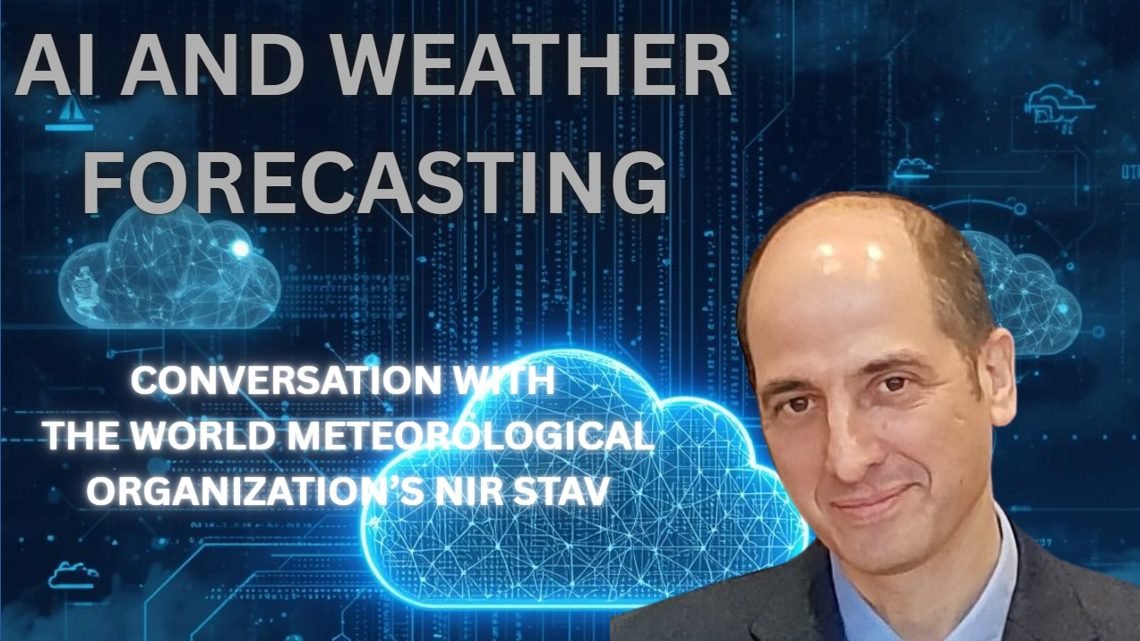
World Meteorological Organization Director Stav Nir discusses how AI is rapidly advancing weather forecasting and what it means for the future of meteorology.
JACKSONVILLE, Fla. — Artificial intelligence (AI) is starting to creep into the way meteorologists forecast weather, but global experts say major questions remain about accuracy, data quality and how the technology will ultimately be delivered to the public.
In an interview, Nir Stav, Director of Infrastructure at the World Meteorological Organization, described how AI based systems compare to traditional numerical models and how fast the technology is evolving.
You can watch the full interview here.
What is the WMO’s role?
Nir, speaking from WMO headquarters in Geneva, said the organization “helps coordinate the work of meteorologists all around the world, be it in modeling… or in measurements and satellites.”
He added that while the Secretariat sits in Switzerland, “WMO is a network of the meteorological services around the world… Wherever you are, you have the National Meteorological Service. It is a part of the WMO community.”
How does AI forecast weather?
When asked what separates AI models from traditional systems like the GFS or ECMWF, Nir said the approach is fundamentally different.
“AI doesn’t know physics… you may call it more a statistical approach,” he said.
Rather than solving equations, AI systems learn from enormous datasets.
“You feed it with: this is what happened, and this is what happens six hours later… and in that way, the system learns,” he added.
They also improve through feedback.
“It learns from errors… it starts to adjust its inner calculations to try and reduce the cost,” Nir said. With proper definitions of error, “the system will gradually get to a better and better result.”
Compare this to normal models, which simply rely on statistical equations for the weather outputs.
How accurate is AI today?
According to Nir, the global meteorological community is already seeing promising results. “Those models are capable of getting very good results, sometimes better than what we had before,” he said.
A major advantage is computational power. AI systems can run simulations “several orders of magnitude lower” in cost, making them “tens of thousands… or even 100,000” times faster than traditional modeling.
He added, “you could run a global model on a PC,” which would be a game changer in how different weather agencies put out model outputs — especially for smaller countries.
Still, performance varies by variable.
“We see it outperforming regular models in some aspects, but not in all of them,” Nir said. For example: “The track of hurricanes are actually forecasted better… while the intensity… and the amount of precipitation is less accurate.”
Can AI fill data gaps?
On whether AI can help in remote or ocean regions where observations are sparse, Nir cautioned that fundamentals still apply. “Garbage in is garbage out,” he said. AI requires good initial conditions just as physics-based models do.
However, he said AI may gain value from “proxies… things that are not exactly meteorological observations but have some information in them,” potentially helping “in regions that are data scarce.” Even so, improving global observation networks remains “essential… even for validating the model.”
What’s the future of AI in weather forecasting?
Nir said predicting the next decade is “very risky,” but signs point toward major changes, especially in how forecasts reach the public.
Future systems may let people ask questions directly and receive responses “not only in text, but also in video,” including potentially an AI-generated forecaster “standing in front of you and giving you the forecast.”